MANDELA, KAUNDA LEGACIES
Unilateral Tug of War
Just in terms of numbers, South Africa and Zambia cannot be equated. Of course. The former outstrips the latter by far: from territorial boundaries dimensions, population sizes and overall demographics, natural resources endowment, optimal economic potential and actual performance, to military power. Numbers don’t lie.
It goes without saying, therefore, that at any one time, any one variable or all highlighted above considered, South Africa will, in real terms, be a much more complex society relative to Zambia. Meaning that politics in South Africa will, correspondingly, be a more challenging enterprise for those involved in the national political leadership arena, whether in ruling power or in the opposition.
Needless to say that there are, indeed, countries smaller than even Zambia, but happen to have much more intricate political intrigues than South Africa. Another time and another place for the last observation raised.
A simple Google search will either confirm or debunk my assertions above, much as it will do with many of my postulations throughout this presentation.
Politics is the science of government. Government is the collective of institutions, including their constituent leaderships and functional personnel. They are created to enforce societal progress rules and policies that are arrived upon by the representatives of the body politic.
The government, or the state, will often reflect the interests of the dominant political parties. However, through corruption and greed, the dominant, ruling political parties may themselves be subtly steered by peripheral influential, manipulative economic forces. These may either be local or international actors, if not a combination of both. In South Africa, the concept called “State Capture” describes the collusion between the powerful economic elite and the government.
Notwithstanding the “State Capture” phenomenon, the interests of the respective political parties are often shaped and differentiated by their cardinal ideologies. An ideology is the summation of ideas based on theories and policies of political and economic engineering of society.
Ideologies are applied in varying ways to indoctrinate particular societies to address and find solutions to existential questions and challenges in certain pre-determined, and non-variable methods. Therefore, ideologies are not only critical for shaping individual countries’ internal living conditions, they also influence individual countries’ international relations premises; i.e. which countries will have mutually cordial diplomatic relations with one another, which supranational institutions the countries will be members of, which international solidarity causes countries will engage in and at what cost, etc.
In contemporary times, historical factors leading to the creation of specific nations often contribute to the kind of ideology adopted, developed, or redefined to suit local conditions. A nation’s wealth, often with particular reference to its relative strategic significance to the major economic and political nations and power blocs in the world, will also have a bearing on the nature of the dominant ideology. A subservient country’s geographical location on the globe can further add to, or reduce its strategic value.
At any one time, a quick reality check will show that relatively newer and smaller nations with both perceived and real strategic importance to the major political and economic giant nations, e.g. the industrialized Western world, have a hard time determining their own, sovereign national ideologies.
Old ties bind some of these emergent states with their former colonial masters from the Western world. Others will be held in infinite indebtedness to comrade states from the Eastern socialist, or communistic countries that helped in their liberation struggles for independence.
It is in the light of all the above that I choose to look at the comparative legacies of Nelson Mandela of South Africa, and Kenneth Kaunda of Zambia. Comparative because of the many critics of Nelson Mandela, who, in my view is unfairly battered in relation to the critics’ view of to whom real Southern African statesmanship ought to be accorded contra Kenneth Kaunda’s legacy too. I specifically address myself to Zambian critics.
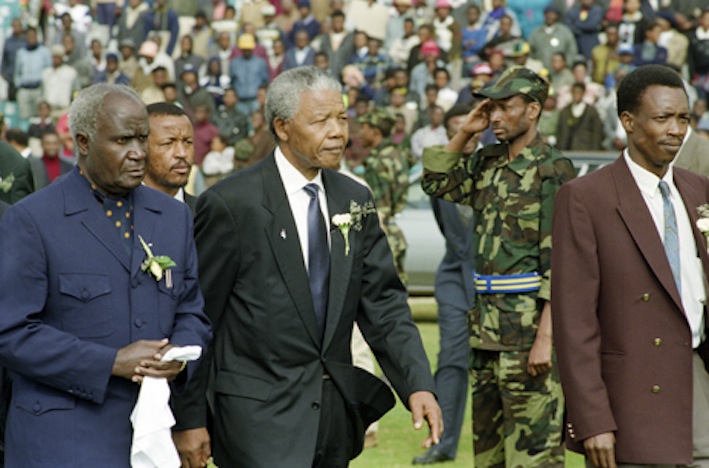
Nelson Mandela attends the lieing in state of ANC president OR Tambo at FNB stadium, Soweto, South Africa. (Greg Marinovich)
Before I proceed, I wish to make a few salient personal points:
- I must declare that this is a non-solicited presentation. It is only an outcome of the involuntary workings of my critical thinking mind and its creative processes. It is my subjective, free world intellectual response to the foul anti-Mandela vis-à-vis Kaunda sentiments I have seen expressed in the various social media platforms, particularly Facebook, for many years. It is not my goal to want to be malicious against anybody. Neither is it my intention to seek or expect approval, favours, or rewards from anybody.
This is an honest, independent expression of my thoughts and feelings with nothing but the very best of intentions. All this is done with the utmost respect both for Mandela and Kaunda, their respective families, and their followers through their respective foundations and other fora … (Continued in the book: “MACHONA BLOGS – As I See It”. Order Simon Chilembo books on Amazon)
Simon Chilembo
Welkom
South Africa
Tel.: +4792525032
February 13, 2018
INTRINSIC MOTIVATION IN A NATIONAL CONTEXT
Guiding questions:
1. What spurs a nation or a people to attain heights of development?
2. Is it a collective that is the main driver or a leader with “Intrinsic Motivation”

©Simon Chilembo 2018
NOTE
The article below is motivated by Mr Fisho Mwale. It arose from a Facebook interaction yesterday, Thursday, January 08, 2018. I was one of the respondents to his posting, “BUSINESS IDEAS”. In it, he referred to his personal family experiences to highlight some cultural impediments towards following up emergent business opportunities in our society.
Mr Fisho Mwale, summarizing his bone of contention, wrote, “Sometimes out of the box great business ideas do not work due to many factors such as timing, cultural values and lack of guts. You have to believe in your ideas and it’s important to get ‘buy in’.”
In agreement with him, I responded:
“… Great real-life entrepreneurial development case study material, …. Thanks for the insights, Sir! I wish to also add lack of what I call “Intrinsic Motivation” to the list of factors inhibiting follow-throughs to great business ideas and, indeed, opportunities arising from given circumstances.
“Intrinsic Motivation is an active killer-instinct driven desire and determination to achieve set goals, and beyond. That arising, perhaps, from chance opportunities, or those created in response to certain apparent societal, if not bigger natural conditions and/ needs. E.g. the cholera epidemic mentioned above. It works independent of external deliberate or unintended hindrances, and is often a profoundly personal journey. Seen from the outside, people in “Intrinsic Motivation” mode can appear to be selfish, reckless, one-track-minded, and defiant, amongst other negative personal attributes.
“This kind of motivation is ignited by desperate survival need circumstances too, if not a pure natural curiosity state of being. When pushed against the wall, without any possible manoeuvre or exit, fearless, “thrill-seeker”-type-people with strong wills to live will find the most ingenious ways to survive: creativity kindled to find the most unconventional solutions that could be developed into business models, subsequently.
I believe that we have to teach ourselves to be hungry enough, curious enough, and afraid enough to ignite our “Intrinsic Motivations” in order that they, pushing the continuum farther, ignite the killer-instinct guts necessary to get us to see things through, no matter the odds. It is a mind, attitude thing, really. Doable.”
The reply from Mr Fisho Mwale was gracious. He concluded by throwing me a challenge, “Thank you and I would love for you to expand more and discuss it from a National context …”
The latter got “… my Intrinsic Motivation to find, and engage with like-minded people about national development issues, plus possible solutions …” to shoot to the roof.
DEVELOPMENT: Attainment, Nurture, Sustenance.
In Social Science, the concept of Development is defined in terms of upward qualitative and quantitative transformation of society over time. Operationally, it means that from society’s observable benefits of this positive change, people will reflect higher and enduring frequencies of subjective states of contentment, hope, and belief in an ever bright future for all.
This state of affairs will be a manifestation of societies ability to provide for all the people’s basic short-term and long-term needs and wants for successful living from day-to-day, all their days: food, shelter, health, education, security, and more. Abundance is when society has a constant surplus of all the resources that are necessary to ensure that the people’s contentment levels do not dramatically spiral downwards in cases of natural calamities, wars, and, especially, population growth in time.
The objective side of Development is, therefore, operationally seen in the growth, in sheer numbers and magnitudes, of material and service values of all the tangible and intangible aspects of societal management towards lasting prosperity attainment. Herein come elements of:
- Infrastructure – water reservoirs, food production facilities (agricultural land, food processing plants, etc), housing, roads, hospitals, schools, power stations and grids, telecommunications, and others.
- Services – the entire spectrum of social amenities and necessary operational personnel across the board (health workers, engineers and other scientists, entrepreneurs, R&D, and many more), national security (police, military), including culture, i.e. the whole possibilities field of the creative arts.
- Longevity – In sustained development states, short of mortal accidents of all kinds, under variable circumstances, people tend to live into ripe old ages. Absence of private and societal want, as well as a general sense and state of well-being in society tend to have a life prolonging effect on the people: resilience against various life-threatening illnesses, and ever improving medical treatments of the same.
Because Development is about growth, and is forward-looking, it can be encapsulated in the concept of progress. This means that stages of development can be measured, and isolated in terms of space and time. Viewed in this regard, it ought to be understandable that Development entails a rise in complications of societal management and administration.
In the context of this presentation, management is about the allocation of resources in appropriate quantities to relevant material and service needs in developmental work. Administration, then, sees to it that resources are applied for their originally intended purposes, and according to stipulated rules with regard to predetermined decisive conditions.
Therefore, from the point of definitions above, for Development to succeed, it is imperative that it is spearheaded by people of at least as intellectually and culturally progressive as Development itself is inherently, and necessarily entails on its reality.
“INTRINSIC MOTIVATION” FOR DEVELOPMENT: The Collective? A Leader?
On the one hand, human beings are inherently self-centered as individuals. On the other, because human beings are, actually, also very smart, they realized a long time ago that to survive in an inherently hostile nature, they had to learn to live in collectives. We, as humans against other earthly creatures, owe our position at the top of the food chain to our ability to work together in our necessary efforts to tame aspects of nature for our, yes, Development (-al) needs … (Continued in the book: “MACHONA BLOGS – As I See It”. Order Simon Chilembo books on Amazon)
Simon Chilembo
Welkom
South Africa
Tel: +27 813185271
February 09, 2018
 Simon Chilembo