Home » Posts tagged 'design'
Tag Archives: design

𝐖𝐇𝐀𝐓 𝐈𝐒 𝐀𝐑𝐓?
𝐀𝐌𝐈𝐃𝐒𝐓 𝐁𝐄𝐀𝐔𝐓𝐈𝐅𝐔𝐋 𝐓𝐇𝐈𝐍𝐆𝐒
DISCLAIMER
I do not have any academic nor professional training in art. My articulation of what art is a function of my layman’s instinctual appreciation of things beautiful against the ugly; both in the figurative and abstract manifestations as my senses perceive it in any given situation and space, at any given time. All I know is how to think and write, and write and think. Art is what I feel. If I feel it, I can think it. If I think it, I can write it. Writing is my art, my artistic expression. Writing is what I do; all attributable to my academic training.
WORKPLACE OF BEAUTIFUL THINGS
People do from time to time visit museums of all kinds for all kinds of recreational, educational, and research reasons. I work at Norway’s Nasjonalmuseet. The institution has proved to be an awesome literary creative’s wet dream for me as an author and poet. I get at least one goosebumps moment each day I am at work. Tens of thousands of works of art are on display throughout the eighty-nine exhibition spaces at the museum. In all their widely variable expressive forms, these artworks move me in a way that ever fills me with love and joy like I have never experienced before. Working here is a privilege I am much grateful for.

At different points in about all the exhibition spaces in the museum, there are rest stations comprising benches upon extensions of which are placed, amongst other items, wooden playing cards. The cards have various quizzes and games for the guests to have a go at as they sit and rest. I, together with Ole, a fine but ever condescending colleague young enough to be my grandson, happened to have been engaged in a discussion about various aspects of the museum when we approached one such station. Ole then unexpectedly reached out and randomly pulled out a card from the bench extension. It turned out to be a quiz card with the question: ‘What is Art?’; creating a gotcha moment that I saw Ole revelling in.

Talking about Ole’s gotcha moment, this was yet another one of those moments in which a person of European extraction comes to me with the pre-conditioned notion that Black people are not cultivated enough to appreciate the finer aspects of European culture. Anyhow, my immediate response, in this case, was, “Art is the capturing of an experiential moment in time and space in order to, perhaps, tell a story about that experience in the future. This capture can be in any form or medium according to the proclivities and talents of the artist.”
Ole, “I hear you. But you will have to elaborate more on all that you have just said!”
Seeing as we had to attend to each of our respective duties at work then, I replied, “I shall write an essay for you, then. Deal?”
“Deal!”

My definition of art shall be both conceptual and functional. Conceptually, I know art when I perceive it. I do not have to be told. I do not have to be instructed. I know art when my senses register it. Regardless of the representational form, the sentimental response that I get from experiencing any manifestation of art that I consider as beautiful is a constant. Conversely, an unattractive, unpleasant artistic form as I experience it emotionally affects me in the same way relevant to it irrespective of the form or the representational style.
Whenever I read a storybook (or even write one) that I enjoy, my breathing rate slows down, and the total bodily relaxation I get gives me a wonderful warm feeling all over; I get goosebumps, and my palms get warmer and moist. This kind of feeling brings me immense joy. The dreamy state it gets me into sends me into a fantasy world of all things possible. If I had been, for one reason or another, going through hard times, this state brings hope home; it fills me with a sweet sense of freedom. In this state, I am invincible. This is my subjective domain for defining what beautiful art is for me as my perceptive senses – eyes, ears, skin, tongue, nose, intuition – register it, feed my hormonal system (feel-good hormones), and the latter instructing my nervous system to induce my being to act accordingly. Pure joy.

Whilst recognizing it for what it is, art that is repugnant to me is exactly that. If it makes me cringe, if it casts a shadow of pessimism over me, if it fills me with negative thoughts and associations, if it gives me a cold sweat, then it is bad art for me. There are times when I can see beauty in bad, ugly art, though. I think about the hands, or some other body parts, that created the work. Every hand shall tell its story according to its owner’s neuro-hormonal wiring and physical capabilities. One man’s apparent gory art may be another’s depiction of heaven. Beauty is in the eye of the beholder.
Functionally, art is a conveyor of messages, a storyteller; a courier of generational narratives in humanity’s dances with nature and itself over time. Art can be an instrument of change. Art can repair the once broken. Art can inspire hope, faith, trust, and love. To the extent that art is a personal expression, art may speak for its creator. Art creators have the potential to make or break society. Ask God, man’s most divisive, master-of-carnage creation. God may have created man instead, her most complex work of art. The outcome is not any better.

Art is identity. Identity may be deception obscured in art. From the outset, art may be true by intent and purpose. But when human perception and interpretation of reality are as polychotomous as there are so many people on earth, art shall be true or fallacious as to the perceptive state and cognitive capacity of the observer. Therein lies the mystique, the intrigue of art. Who am I? I am a man in love with art.

Art is some powerful stuff. Art is a human creative potential deserving to be handled with tender, loving care. At its best, art is an instrument of peace; art has the potential to stimulate reflection on the human condition. We rise, we fall; art captures all that. Art is beauty. Without beauty, life is not worth living.

Beauty moves humanity forward and higher on the scale of qualitative and quantitative improvements in life. It is not for nothing that nations of the world, interest organizations of all sorts and sizes, wealthy individuals, and many others invest heavily in the promotion, conservation, preservation, and storage of some of our most impactful artworks over the epochs into the future. Art immortalizes human experience.

SIMON CHILEMBO
OSLO
NORWAY
TEL.: +92525032
April 07, 2023
RECOMMENDATION: Do you want to start writing own blog or website? Try WordPress!
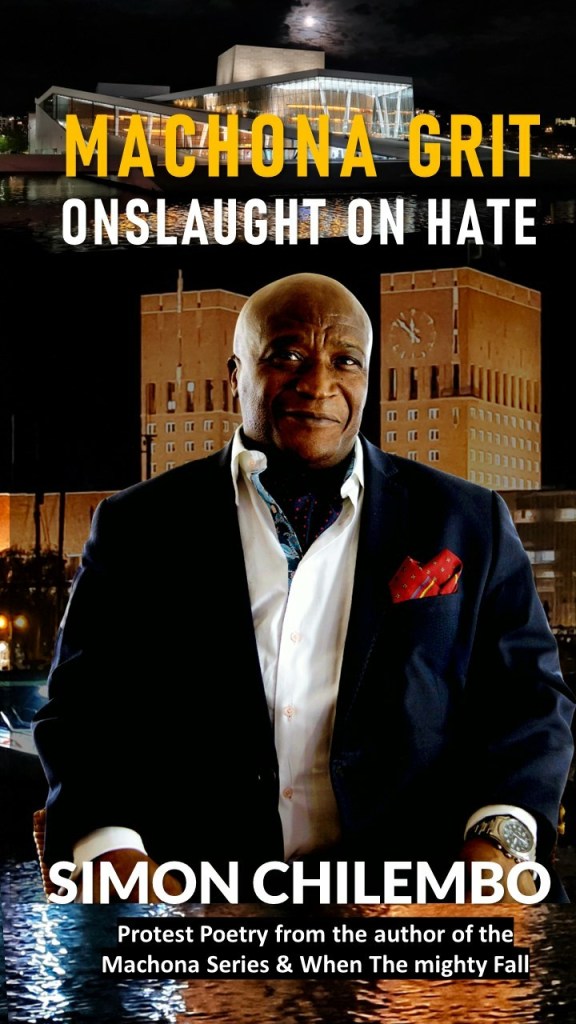
Order, read, and be inspired by my latest and 9th book, 2nd poetry volume, MACHONA GRIT: Onslaught on Hate
LANGUAGE AND DESCRIPTION OF EXPERIENCE: COVID-19 OUTCOMES CASE
IT IS WHAT YOU SAY
More talk on how to cope with survivor issues around outcomes of Coronavirus disease (COVID-19) on a personal level. Talk structured around principles of my COOL Coaching (Chilembo Optimal Outcomes Life Coaching) method*.
Pivotal point in awareness of language usage: “Reality manifests itself with impressions that the mind creates as from the language it processes,” Simon Chilembo.
E.g.
1. Ahmet Altan: “… like all writers, I have magic. I can pass through walls with ease.”
2. Mwamedi Semboja, Twitter account tagline: “You can travel anywhere, just by closing your eyes.”
Earlier presentations:
1. SHOULD I DIE: COVID-19 Reflections
2. CORONA VIRUS DISEASE COVID-19 SHALL FALL: My Reason for Optimism
3. Ode to Manu Dibango: WALK SOUL MAKOSSA
4. SIMON’S KITCHEN IMPROMPTU COVID-19 QUARANTINE VEG STEW
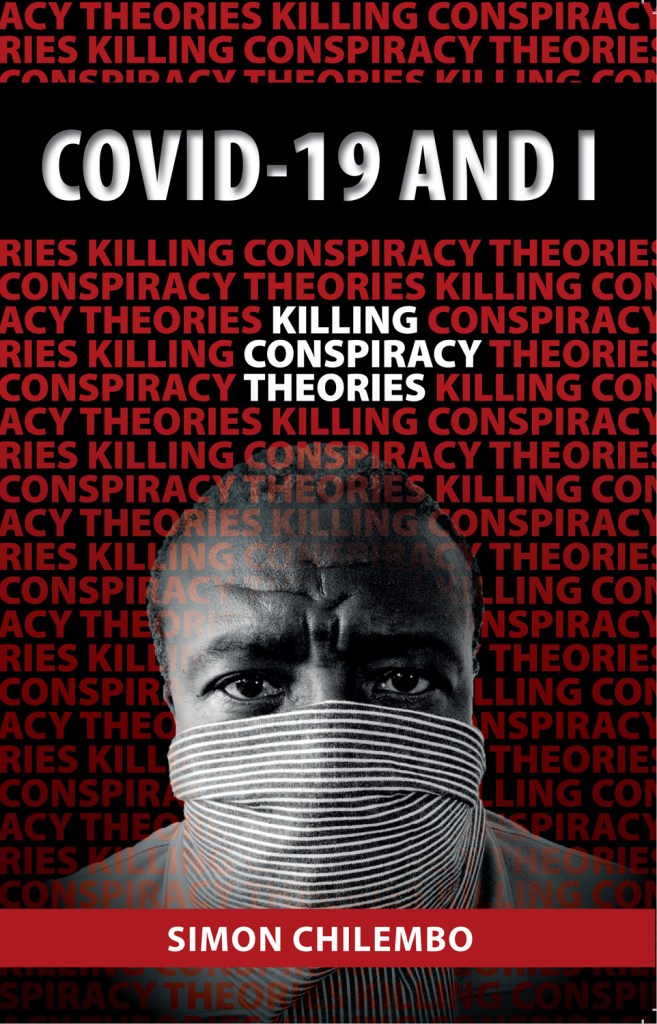
*Subsequently edited and presented in the book Covid-19 and I: Killing Conspiracy Theories)
SIMON CHILEMBO
OSLO
NORWAY
Tel.: +4792525032
April 14, 2020
PS
Order, read, and be inspired by my latest book, Covid-19 and I: Killing Conspiracy Theories.

RECOMMENDATION: Do you want to start writing own blog or website? Try WordPress!
SHOULD I DIE
In 1998, my father died solitary in a bachelor quarters in Tshwane, South Africa. My mother followed twenty years later. Pneumonia related complications in both cases.

©Simon Chilembo, 2020 Author, President, ChilemboStoryTelling™
There were about eleven other fellow patients in my mother’s ward at the hospital in Thabong, Welkom. She had kept everyone awake all night with her moaning in pain, crying out an unknown name all along. Nevertheless, she managed to eat her 0700RS breakfast that fateful Sunday morning; much to everyone’s delight since she hadn’t had much appetite the two previous days. After eating she fell asleep.
When my nephew, Kgosi, and I went to check on her during the morning visit hour between 1000-1100HRS, we found her sleeping peacefully. Apparently. After hearing the report by fellow patients about my mother’s restless night, we thought it wise not to immediately awaken her. She could have her full sleep during the course of the morning, and we’d come back to see her again in the afternoon as per routine.
Fifteen minutes into our arrival in the ward, an impatient family friend found that my mother was cold and lifeless. A few minutes later, a doctor declared her officially dead. She had probably died two hours earlier. No one had taken notice. It was one of those cases of “She died peacefully in her sleep”, I guess. Perhaps the same may be said about my father. He had been dead for about two days by the time his corpse was found in his residence.
I opt to convince myself that, indeed, both my parents died peacefully in their sleep when their respective times to go arrived. Neither was surrounded by their loved ones upon breathing their respective lasts.
The thought of whether or not my own death will pounce on me in solitude has been on my mind since February, 1991. I had for the first time ever gotten ill with what I later understood to have been an acute attack of the flu. Bedridden with high fever and profuse sweating for three days in my single student room, I was so weak that I was unable to lift a telephone sitting beside me on my bed to call my school or doctor in Oslo.
One week later I had recovered without having had received any medical attention. An older, more knowledgeable friend told me that I had actually had a close brush with death. Perhaps I should consider getting myself a wife, he suggested. He argued that many people who live alone tend to die unnecessarily because there is often nobody there to render immediate assistance in times of emergencies.
In the northern hemisphere spring of 1995, I had a first-time mean attack of hay fever. I didn’t know what it was at first. For many days I kept sneezing like what I thought was like a mad man. Then I began to cough as inexplicably madly. What I thought sounded like a small cat soon started mewing in my chest. This made breathing painfully difficult even at the mildest physical exertion. Then I knew I was in trouble.
At great financial cost to me that I could afford regardless, a former lover at that time then finally hastily made it possible for me to acquire an emergency cocktail of various tablets, capsules, and an assortment of asthma medicines. Had I been alone at that critical time, I could have died from pneumonia, the former lover said later.
Today, the Coronavirus disease (COVID-19) pandemic, moving at a frighteningly fast pace is threatening human life across the globe. The United Nations and national governments are taking drastic and, in some cases, Human Rights defying draconian measures in individual and concerted efforts to isolate, treat, control, and eventually effectively manage the disease. The ideal situation would be to eliminate the disease, of course. But it’ll take time to develop necessary relevant curative and preventive medicine. Researchers the world over are currently working at break-neck speeds to achieve the latter.
Millions of people are under various levels of quarantine throughout the world, depending on suspected or actual infections and severity. Much of the industrialized world is under lockdowns. People whose immune systems are compromised from before are dying rapidly. Some people are quarantined in their private homes with their near family units. I am alone in my abode.
I am feeling well and strong. I can’t help, though, but think about my mortality in the event that my health should take a sudden, COVID-19 related downturn. Some other shit could happen too. One never knows when shit will hit the fan. I can’t help but think that were I to die now, I sure would do so peacefully. I’d die with no beloveds of mine surrounding me. If it happened to my parents it might as well be the same with me. Family solidarity. Family tradition. I’m their eldest child after all.
Like my parents, I leave no great fortunes behind. It’s just as well for me that, unlike my parents, I leave no children behind. As to whether or not it’s a good thing to die as my corpse shall be in a cremation oven, I shall find out upon arrival on the other side.
In the meantime, I can’t help thinking about one of my all-time favourite songs: If I Should Die Tonight, by Marvin Gaye … (Continued in the book Covid-19 and I: Killing Conspiracy Theories)
SIMON CHILEMBO
OSLO
NORWAY
Tel.: +4792525032
March 15-16, 2020
PS
Order, read, and be inspired by my latest book, Covid-19 and I: Killing Conspiracy Theories.
RECOMMENDATION: Do you want to start writing own blog or website? Try WordPress!
GOD IN MAN
SCIENTIFIC MAN OF GOD
Epigenetic inheritance theory has captured my fascination in a profound way. It has cast new insight into how I now think about the nature of man. That with reference to how I relate to man in the spontaneous, continuous process of writing and playing my own story as I go through the labyrinth of life. Some call it legacy.

©Simon Chilembo 2017
But I don’t really care much about “the legacy I shall leave behind”. If I do have a legacy, it has, actually, built, and shall sustain itself for as long as time wants it alive. Nevertheless, immortality is the goal. Who wants to live forever? I do. Why not?
All I care about is the integrity of the authoring of my life story lines as I dance my way through to my exit point of the maze that far, far away.
My hope is that my life story shall be read and judged with open, scientific minds, both whilst I still walk the face of the earth, and when I’m dead.
Thanks to epigenetic inheritance theory, I have finally seen the light: yes, the human body is, indeed, a temple of God. By extension, any other creature that subscribes to, and lives according to tenets of any prescribed faith, has its physical body as the temple of God; at least in the Western world’s perception of the Deity.
Even more precisely, the philosophical duality of God and her anti-thesis, Satan, is not only a construct of the core of man’s existential questions’ thinking: their abodes, heaven and hell, respectively, are, in fact, in the DNA of man.
There is no place called heaven outside the realm of man’s existence on earth. Neither is there a place called hell in the same illusory domain. Heavenly rewards, or satanic retributions for our virtues and sins, respectively, we live them accordingly right here on earth. When we die, we are dead: our DNAs have switched off from our consciousness, and so have the ideas of God, Satan, heaven, and hell.
It is only the unenlightened that fuss about life after death for the deceased. The human soul leaving the dead is as real, as independent, and as infinite as the universe. So, leave it alone. It knows how to take care of itself. Ever heard of a buried soul? They failed to bury Jesus.
It ought to make perfect sense that life-after-death is, indeed, a reality for the living only. Life goes on. But, living in the dark, and confronted with challenges of life with nature, the survivors seek answers outside of themselves. Finding no workable solutions out there, panic grips them. Fear of the unknown rules over their lives through and through … (Continued in the book: “MACHONA BLOGS – As I See It”. Order Simon Chilembo books on Amazon)
Simon Chilembo
Welkom
South Africa
Telephone: +27813185271
December 19, 2017
eKASSIE THABONG
THABONG, KASSIE YA KA KA 2014

©Simon Chilembo, 2014
On Monday morning, walking the breadth of my old Kassie, Thabong, Welkom, for the first time in 40 years, by way of pungency in the air, nothing has changed. After 2-3 weeks of torrential rains, there is stagnant water in many places.
The superlatively built storm canals are clogged; green sediment/ moss and wild vegetation growth all the way. Burst sewerage pipes here and there; long, open canals of slow-moving, if at all, shit created as a result of slow and/ or erratic maintenance.
As if ordered, there’s a carcass of a cat on the edge of a busy taxi street. Indications are at the cat hasn’t long been run over by a vehicle. No doubt, there is also a dead dog nearby, perhaps somewhere in the messy storm canals. No need to confirm. Dead dog eKassie? I know it when I smell it. Just keep on moving straight ahead. Nose getting blocked. Getting a headache. Feeling queasy.
How did I grow up in these conditions? How do people, how can people still be living in these conditions in Mzansi, the golden land of milk and honey for sho? No wonder old people seem ever so tired, and “ugly” here. Been away too long … (Continued in the book: “MACHONA BLOGS – As I See It”. Order Simon Chilembo books on Amazon)
Simon Chilembo
Welkom
South Africa
February 13, 2014
 Simon Chilembo