Home » Sport (Page 3)
Category Archives: Sport
38 YEARS AN EXILE: X
HOME AT LAST! Part 10
LIFE IN THE DIASPORA – MUCH TO PROVE
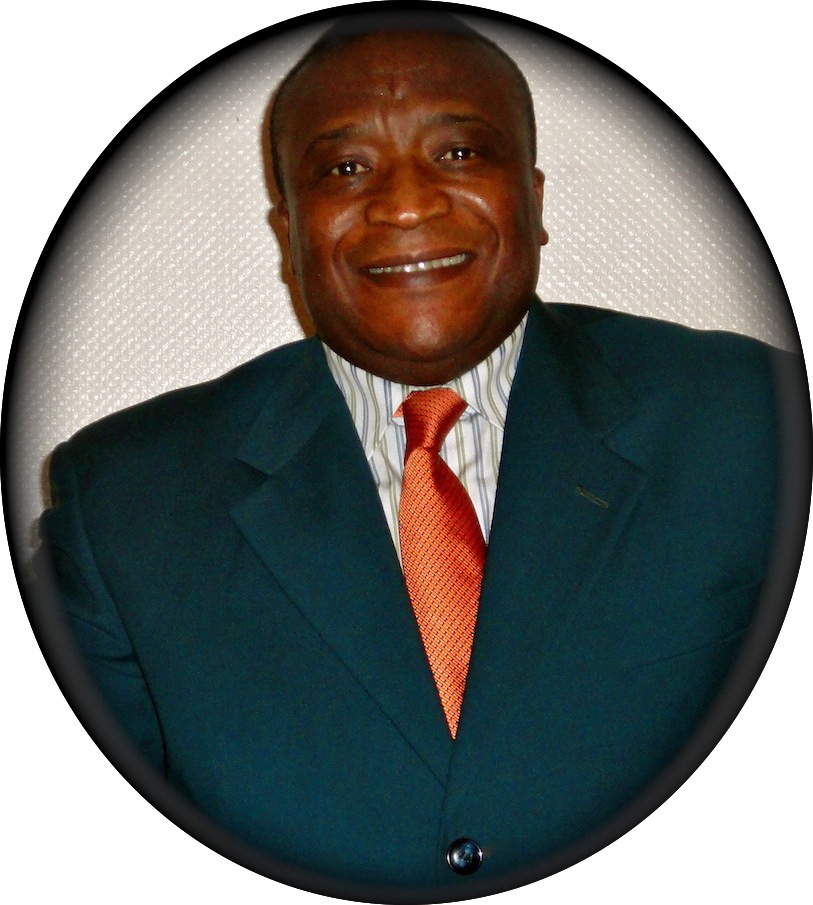 Once you land in exile, even more so if you do eventually get stuck out there, you have everything to prove. You have to. Your life depends on it. Exile confronts you first and foremost as the individual. Troubles in your country of origin will only make sense, or not, on the basis of what story you talk and walk. Consciously chosen or not, it may be your mission to be a Messiah for your people. Prove that you are; their lives depend on you.
Regardless of your real or imagined social status in your homeland, the fact that the latter and yourself can no longer thrive in each other’s presence, and because countries do not move, people do, you hit exile with much of you hanging on the line … (Continued in the book: “MACHONA AWAKENING – home in grey matter”. Order book on Amazon’s CreateSpace here).
Simon Chilembo
Riebeeckstad
Welkom
9459
South Africa
November 25, 2014
38 YEARS AN EXILE: IX
HOME AT LAST! Part 9
WALOBA AWARD 2014
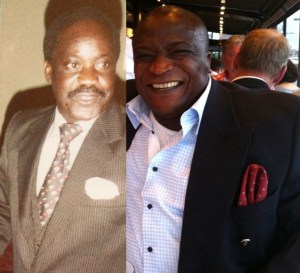
E L W Chilembo, S Chilembo
My father the original exile, Mr Elias Lazarus Waloba Chilembo, would have turned 83 years old on Wednesday, November 19, 2014. When the pangs of British colonialism induced poverty were too much to bear, he, like his own father before, Waloba The First, trekked from our remote village in Eastern Zambia, to South Africa in search of greener pastures. This was soon after the end of World War II, in 1947. Four years later his mother died. He came back home to bury her. As per clan norms among my people, he being the eldest offspring in my grandmother’s house, Pappa should have stayed on to help Waloba The First look after his large, polygamous family. But no, he preferred to go back to exile in South Africa, where he would firmly plant his own roots in the land of diamonds and gold by eventually getting married, and establishing a family … (Continued in the book: “MACHONA AWAKENING – home in grey matter”. Order book on Amazon).
Simon Chilembo
Riebeeckstad
Welkom
South Africa
November 20, 2014
SMARTER ZIMBABWEANS, STUPID SOUTH AFRICANS?
IS IT TRUE OR NOT THAT ZIMBABWEANS ARE MORE SMARTER (sic), EDUCATED THAN SOUTH AFRICANS??
Asked somebody on a Facebook group, The SA Political Forum (no longer exists).
A clumsily formulated, but interesting question which has provoked extremely intense debate on the forum in recent days. The latter manifesting more the worst than the better of our views of one another in this part of the world: nationalism, racism, tribalism, bigotry, parochialism, xenophobia, ignorance, primitivity, nauseous arrogance, pettiness, immaturity, insensitivity, paternalism, mental derangement symptoms, lack of imagination, intellectual poverty, academic disorientation, non-culturedness, superstition, spiritual emptiness, insecurity, dumb-headedness, self-destruction tendencies, predator mentality, terribly developed language/ communication skills, cheap rhetoric, thick-headedness, anarchism, mistrust, misinformation, information distortion, history misinterpretation, manipulation, wilful ignorance of facts, e-kassie mentality, ill-defined defiance, profanity, foolish pride, as well as threats; including leadership/ rule by fear.
I do not quite recall how my first year, 1965, at school in Lesotho unfolded. What I do remember well, though, is that it was a hell lot of fun learning how to read and write for the first time. Returning from what I had then understood to have been Christmas holidays, January 1966 I discovered that I had completely new classmates at my school. The others from the previous year were in another class I heard called Padiso/ Sub B.
That didn’t bother me much, however; all I wanted to do was to continue learning how to read and write. It was ever such great fun, at the request of the class teacher, to stand in front of the class reading or counting for my new classmates. Nevertheless, I recall that at some point this whole thing began to bore me half way to death; I kept reading and counting the same things all the time. I felt it was time I went to join my old classmates who were now in Padiso/ Sub B. So, I stated my wish to the class teacher.
The school principal wouldn’t allow that to happen, I was told. Why??? “Because you are just too intelligent for your age, Simon. Boko ba hao bo tla bola …/ Your brains will rot if you go to higher classes while you are still under age. People who get too much education while young get mad, you see. Don’t worry, you shall go to Padiso/ Sub B when you are 8 years old” the teacher resolutely told me. So, I stayed in Grade 1 for three years, 1965-67, to keep my sanity together. Jeeezuz!
During the years 1967-69, the only meaningful school activity I recall are the almost daily after school fights arranged by older boys and girls. The idea was that boys my age should/ would beat the brains out of me because teachers at the school never stopped talking about how intelligent I was. Sadly for the matchmakers and my opponents, I would win absolutely all my fights. There was no way I was going to allow these dumb heads to kill my brains. I was also a street-smart kid.
The thing is, while these age mates of mine were still working around getting the alphabet, and numbers, together, I was already reading to my class teacher and my grandmother some passages from the Lesotho Times newspaper. I am a South African child begotten of a Zambian father. At this formative school of mine in Lesotho, there were many other mixed ethnicity parentage children (representative of the ethnic and racial diversity of the Southern African sub-continent) from relatively more resourceful families in the major South African metropolis, including Lesotho itself.
In 1970, going onto my tenth year of age, I find myself in a South African school classroom for the first time. The academic excellence self-confidence developed in Lesotho got acutely shaken by my failure to understand what the textbook I was given by the new class teacher was about. Reading comprehension, of course. I struggled through the assigned reading passage, and then answered the subsequent 10 questions best I could. I got zero out of ten.
The teacher expressing dismay at my explicit lack of knowledge of Afrikaans, I couldn’t reveal that I had actually started schooling in Lesotho, where there was/ is no Afrikaans spoken or taught in schools. By the time of the mid-year exams in June that year, though, I was scoring the highest all-round grades in class
Upon return from winter holidays, my class teacher called me out to where she and other teachers were apparently discussing something serious together with the school Principal. I was told that all had agreed that I deserved to be promoted to the next class because I was just too intelligent for Grade 3, which I had in fact been forced to repeat in the first place. I declined. Why? I was afraid my brains would rot, and I would thus go mad from too much education while still young. Bummer! I kept scoring the highest grade point averages at school in South Africa till end of 1974.
First quarter of 1975 I am in Lusaka, Zambia. No school that year. Very depressing. I have never felt smaller, and more insignificant. Shattered medical studies dreams. But then again, just under 15 years of age, I discover, and enter into a space called library for the first time in my life: Lusaka City Library, British Council Library, American Library. Book, books, and books everywhere, including my Uncle Oliver’s private library at home, as well as later, the magnificent UNZA library. And there were so many magazines, journals, and other publications of all sorts to read. I became a bookworm that year. A whole new world of thinking and dreaming was opened for me; and thus began my daily English reading and writing journey to this day.
Back to school in 1976. Forced to backtrack again because, my father was told, the then South African Bantu Education Grade 7 academic standards were lower than those of Zambia. But, as soon as I had gotten into the rhythm of things at school, I was topping class grade average points, as usual. I could never understand the Grade 7 failure panic and hysteria characteristic of the time in Zambia. I, of course, passed the final exams with flying colours later in the year.
South African born, Zambian dad begotten man-child would show constant, and predictable, academic excellence throughout the entire Secondary/ High School career to university; crushing class- and schoolmates from many other countries/ nations of the world, including Zimbabwe. This, despite the fact that I didn’t know what a science laboratory was until I was 17 years old at secondary school. That Zambian school children had already been exposed to sophisticated scientific education for years had also greatly intimidated me at first. There was at that time an awesome Zambian youth scientific magazine called Orbit. The story would repeat itself in Norway, both academically and professionally in my adult years.
20 years ago, after failing a Drivers’ Licence theory examination in Norwegian language, a blue-eyed Norwegian young man, upon hearing that I had scored almost 100% in the same test, exasperates, “Fffæææn/ Ssshit, I never knew that there were in fact wise negrer in the world!” Another dick head bites the dust.
The moral of this story is that when you are hot, you are hot. Your origin, or Nationality, due to various objective and subjective factors, may have some, but certainly not, decisive bearing.
My initial response to the question on the forum went as follows:
NOT true! The 5 million or so … in SA should tell a lot about Zimbabweans’ smartness, with their country messed up by (one of) the most educated presidents in Africa. We have our Msholozi, we have our legacy of inferior, for Blacks, apartheid Bantu education. But, for one of many examples, and despite acute imperfections here and there, through SASSA, South Africa effectively distributes at least R 10 BILLION in various social grants a month.
Ultimately, it’s not so much about how smart or educated Nation(-s/ -nals) are, it’s about how they apply these qualities to meet their people’s needs and aspirations as their nations develop and progress among nations of the world.
Simon Chilembo
Riebeeckstad
Welkom
9459
South Africa
Tel.: +4792525032
October 12, 2014
ETNISK NORMANN SUPER STAR
HOW TO BECOME A NORWEGIAN, FOR THOSE WHO WANT TO BE
If Youssou N’Dour plays Ethnic Music, then I am Ethnic Norwegian.
 Everybody loves a Super Star. The statement discounts snobs, fundamentalists, the ignorant arrogant, the uncultured, the uneducated, the primitive, the anti-social, the eccentric, the naïve, the narrow minded, the bigoted, the untalented, the gutless, the envious, and the jealous.
This posting is my message to 1st-Xst generation immigrants to Norway struggling with identity, as well as insecure sense of belonging in and to the country. These will be a mix masala mix of people from all countries of the world whose music Westerners refer to as Ethnic Music, collectively called The Third World. They will have skin colour tones divergent from the conventional European one, called White.
These immigrants will have decided to make Norway their new home. They will have adopted Norwegian citizenship, abiding by the laws of the land, and contributing to the growth and development of the country, each in their own ways in all areas of human endeavour. Singing Ja, Vi Elsker when and where appropriate will have become second nature to these people. Come 17. mai year after year, these people rise and shine in front of the King and the Royal family.
Those immigrants to Norway who are in the country temporarily in any capacity, here for 1- X years, need not bother to read this posting … (Continued in the book: “MACHONA BLOGS – As I See It”. Order Simon Chilembo books on Amazon)
Simon Chilembo
Welkom
South Africa
September 10, 2014
KARATE KID FROM THABONG RETURNS
FORWARD TO THE ROOTS
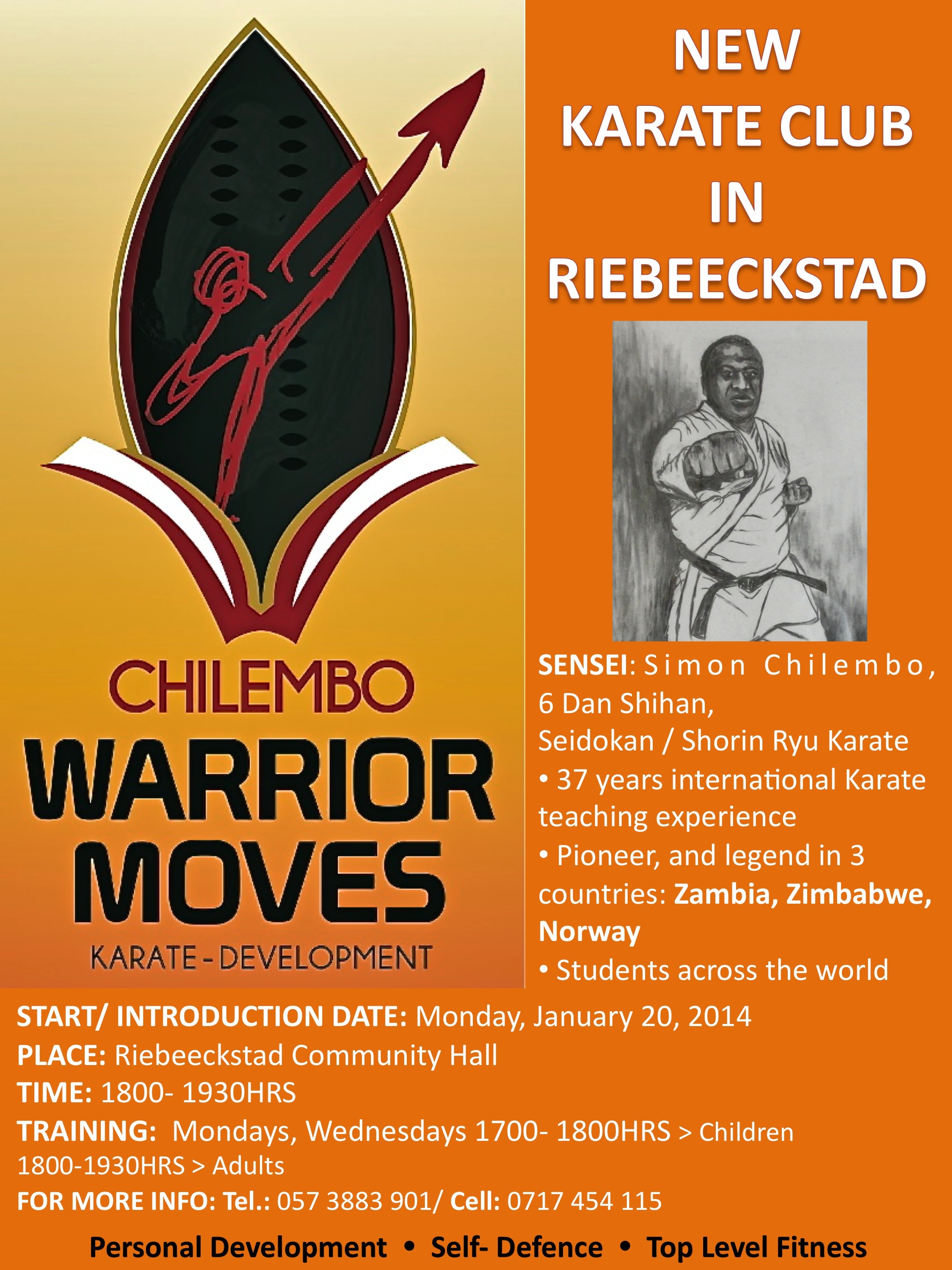
To mark my resumption of Karate teaching after a 2 ½ years’ semi-retirement, I take the liberty of reproducing an edited version of an interview I had with what are considered to be, in Karate terms, my Karate grandchildren in Zimbabwe. It is worth noting that my comeback is done in Welkom, the city of my birth in South Africa. This is where the adventure began.
BM: We are excited to be interviewing Simon Chilembo, Sensei, as a known pioneer of Seidokan back in the day. We hope to patch in some history that has been hazy, and we are grateful to people like Simon Sensei, who in many ways were responsible for linking Zimbabweans to Stephen Chan, Sensei, and responsible for shaping Jindokai as we know it today
1.BM. Sensei, many thanks for agreeing to this interview. We hope that we can go back with you in time. Please tell us how Sammy Chilembo was drawn to Martial Arts, and when this happened?
SC: I have always fought. First, as a smaller than average, sharp-tongued child protecting myself from others making my life difficult in various ways.
Second, defending myself as a mobbing victim, given my sudden growth in body weight and size from near pubescence to early teens.
Third, protecting my two siblings and myself against xenophobic and tribal inspired verbal and physical abuse arising from our father’s non-South African origin. There were also some direct responses to racial abuse and attacks in the then Apartheid South Africa.

©Simon Chilembo, 2014
I first started with Boxing from about age five. Christmas holidays 1971, in a street fight, I’m warned that someone was about to throw a stone at me from behind. I turn around to find, a few meters away, the boy raising his right arm to effect the throw.
Without thinking of it, I ran perhaps five steps and then flew on to the boy, kicking him with my right leg square in the face before he could throw the stone. Years later I’d understand that I had then performed something similar to a Tobi Yoko Geri.
Afterwards, people kept asking me where I trained Judo. I didn’t know what they were talking about; so I kept saying it was secret! It was during my ensuing investigations about Judo that I, a few months later, discovered James Bond. An older guy told me that Bond was a Karate expert, and there and then I knew I wanted to train Karate so as to be cool like Agent 007.
2.BM.Your first formal Karate, was this under Seidokan? When did you meet Chan Sensei?
SC: Although I now know that that the guy hadn’t gone very far in his Karate training then, I like to acknowledge Lefty as having been the first-ever person to give me a formal Karate training session sometime in 1972. Lefty was one of the few older guys really nice to me in our township in Welkom, South Africa.
He taught me Heisoku Dachi, Oyoi, Rei, and Hachi Dachi. Other than that I do not recall what exercises we did. But there sure was a lot of pain and sweat. And Lefty said one thing I never forget, “The most important thing in Karate is respect!” When I look back I think he could have meant “humility”.
I first met Chan Sensei in early 1981.
3.BM. How did Sedokan end up being such a force in Zambia, and later on Zimbabwe? Who introduced Seidokan in Zimbabwe?
SC: Regarding Zambia, my view is that at a very critical point in time we find at UNZA a spontaneous student convergence of the best and most promising Karateka in the country in the late 1970s to the mid-1980s. Then, at about the same time enters the scene an unusual Chinese Sensei Chan from New Zealand.

©Simon Chilembo, 2014. Cream of Zambian Karate, 1983: UNZA
Sensei Chan’s style, approach, and attitude are like nothing we had ever seen before; very generous, very patient and tolerant, open, and inclusive, as well as innovative.
Sensei Chan subtly broke all rules of everything we thought we knew about fitness training, and all of the basics, kata, and kumite training. From this, we emerged with a new style of fighting, which was more mobile with more circular and spinning techniques, including takedowns.
At the same time we were all allowed to maintain and develop further our own individualities, such that it was difficult for opposing teams to find workable strategies against us who stood strong as a team, and yet performed so very differently individually. Respecting and developing further the uniqueness of the individual within the confines of certain specific techniques and methods has been a trait upheld since.
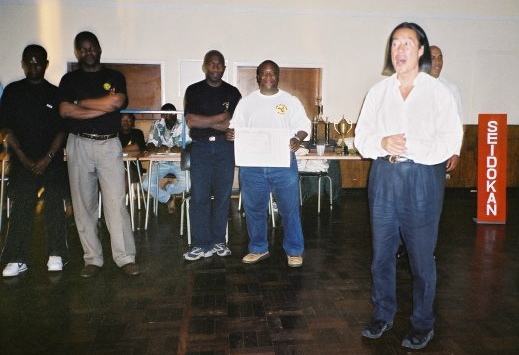
Jimmy Mavenge, second from left.
The late Jimmy Mavenge introduced Seidokan in Zimbabwe. Working then against very strong forces in Zambia, I facilitated this. When I heard that Zimbabwean Karate was represented in the World Championships 2012, I celebrated quietly, and thought, “You made it, Jimmy!” This is how it all started (excerpt from earlier correspondence to a friend):
[One Sunday morning early 1983, a BMW 5 series parks outside my home in Lusaka; and out comes the biggest and ugliest man I ever saw. Upon seeing me his face lit up brighter than the happiest baby face I ever saw… Although I had never met or heard of this man before, he spoke to me like we were like the oldest of friends (he had done some good research on me apparently). And, to be honest, Jimmy had enough charisma to kill the biggest elephant.
After introducing himself: Jimmy Mavenge, Green Belt holder, First Secretary at the Zim High Commission in Lusaka, on a 3 year tour of duty, he went on something like, “Zimbabwe Karate is polarized and racist. I want to change all that when I get back. Black people don’t go above Green Belt there; and I want to take Karate to the poorest of children in my country. You have to help me with this. I’m willing to pay you generously if you can give me a crash-training programme so I can return to Zimbabwe with a Black Belt. I am willing to work and train every day, I’ll do anything you want me to…!”
I remember my jaws sagging, my eyes bulging, with me saying a low key “Wowww…ohhhh…. ok, let’s do it!” I told him though that given the magnitude of the ambition, we had to this properly by engaging the then Zambia Seidokan…]
Unfortunately, we initially received neither understanding nor support from the others. Only because both Jimmy and I were both mad thickheads, we unilaterally went ahead with the project any way, getting a lot of battering along the way. Rest is history; speaks for itself.

©Simon Chilembo, 2014. With the legendary Super Fighter, Lemmy Ngambi, Lusaka, 1987/88
4.BM. Taking you back in the day, who were some of the young men you trained with? You being a champion back in the day, who was your most difficult opponent?

©Simon Chilembo, 2014. I hit the bag as hard as I like. Nobody gets hurt.
SC: When it came to kumite I was my own toughest opponent because I was just too strong and temperamental. With a history of disqualifications and injuries both inflicted upon my opponents, with me getting my own share, I do not have an impressive competition kumite record. Kata was, and still is my thing. I must mention though that, in my opinion, Lemmy Ngambi (late) was the most formidable fighter we had in Zambia during my time … (Continued in the book: “MACHONA BLOGS – As I See It”. Order Simon Chilembo books on Amazon)
Simon Chilembo
Welkom
South Africa
January 19, 2014
PROBLEMS, PROBLEMS!
SIMON CHILEMBO FOR PRESIDENT! Part 2
“Simon, Simon, I know you all 30 years of Oslo and everything about you is problems, problems, problems, … Simon, please, Bello, can you not just for one day, today, have no problems, please. Problems, give me problems every day. I get a headache. NO PROBLEMS, PLEASE!!! I beg you, Simon, Sensei!” my first Norwegian friend, and Brother, Mimmo (72), Italian, would often cry in frustration. And we’d then go out and eat pasta, pizza, tiramisu; drink red wine and espresso, and live happily ever after, sharing our fantasies about good fortunes, women, as well as our frustrations about Karate politics in Norway and all over the world.
 The root cause of all my problems is that I do not have a rich and generous uncle I can cry on to and, voila, I live happily ever after. I have problems. Big problems. Serious problems:
- Across the street in front of the house I live in there is a piece of prime land I want to buy. Here, I can build a modern open-air training and art park for the community. Promoting Health & Wellness principles and attitudes for a healthy, strong, and productive nation. But I’m broke
- I need to pave up the space in front of my house, not only for aesthetic purposes, but that would further stabilise the earth around the house. Broke.
- There is an urgent need to fence off the yard to the street. More for privacy needs than security. Broke.
- Lots of repair and upgrading work to do around the house. No deal. Broke.
- I need some classy interior decoration job for the house. No deal. Broke.
- I need to make the house a green one, with solar energy panels and all, as well as own water borehole. No deal. Broke.
- I must have super high speed ADSL connection here. No deal. Broke.
- A swimming pool is needed too, so is a billiard room, private gym, as well as a private study/ library. No deal. Broke.
- No Maserati. No Mercedes. No Maybach. Not even a Mahindra workhorse van. Broke.
- Future mother of my children taking her time to find me. The house is too big for one man.
- I have produced too much food in my new vegetable garden. Abundance everywhere in suburbia. Problems, problems.
Never ending wars in Africa. African people made destitute in their own lands. African people hungry, dirty, maimed, sick, miserable, broken. African people die without dignity; no honour.  There is that picture of a vulture waiting for an emaciated body of a child to die. African humanity crushed. African earth carries so much unholy rot. And to think that we eat of the soil of this rotten earth!
“But, no, Simon, the oil give it shine; gold and diamonds give it glitter. African blood, flesh, and bones precious, see? They don’t call it the Blood Diamonds for nothing, yes?” I hear an army General whisper in my ear as someone applies electric shock to my testicles.
And African poets sing, “Oh, how we love you, Mother Africa!” Gawd!
Ever a thin thread of hope left, though. In extreme times, a thread of grass, a drop of water can take one very, very far. Beaten African people cross the Sahara on barefoot. Nature is more sensible than we often realize. When people are as badly crushed as African people on the run from miseries of tyranny and wars, even the sun gets no thrills out of burning them alive in the middle of the deserts. Others will deal with them more efficiently.
If you can’t get your hands on the African oilfields, the blood diamonds and gold (platinum is Marikana, and that’s another story), there is bounty of poor, desperate African people on the run across the Sahara. Here, there is everything for everybody. Unknowingly, these acutely abused and misused African people will even buy passports to die out at sea when then sun spared their lives in the deserts. Makes me wonder what the fish of the waters between African inhumanity and the lands of hope and perceived better life beyond, think of Africa and Africans. What would happen were the Nile to reverse its course?
I have problems. Big problems. Serious problems. Solution? Well:
- Leave my uncle alone.
- Burn the money.
- Screw the house. Screw prime lands.
- Leave future mother of my children alone.
- Drive my dream cars to hell.
- Just give me that job – Pioneer Professional Chief Executive President of Africa. Ma-a-an, will I fire people, to begin with!!!
Simon Chilembo
Welkom
South Africa
Tel: ++4792525032
December 28, 2013
PLANET EARTH: WHITE MAN’S WORLD
SPECIAL NOTES:
- I once again state emphatically state that I am the proudest Black Man I know. And, believe me, I happen to know many, many proud and great Black Men. Starting with my own father, through Muhammad Ali, to Nelson Mandela. And then there is Barack Obama.
I know my strengths, my capabilities, and my potential. Behind every manifestation of real, fake, or fantasised weaknesses, I am at least ten times stronger at any one time. Do not try, do not test, and do not threaten me. I promise you, if you live, you may not be able to tell the story. “You think you are some kind of a God now Simon, don’t you?” I am God. Only no religion, no followers. Just Black & Proud. I tell it like it is, as mine eyes behold. - I make some strong subjective claims in this posting. Were this an academic PhD thesis, I would substantiate every claim I make, of course. But that has to wait until such a time I do get into some serious PhD program in one thing or another.
Day before yesterday, the lady newly employed to come and assist us with domestic chores and all, does not report for work at the agreed upon time. My younger sister calls her on the phone. It turns out the lady had opted to go out to attend to some official bureaucracy errand instead, and that would keep her away all day. The same had occurred last week Wednesday.
Upon complaining to a girl friend that had recommended the lady, the friend says to my younger sister, “Our people are really strange. Had you been White, the woman would have told you, and requested for leave of absence in advance! Our people have no respect for work, not in the least us, who employ them, especially when we pay them well, and treat them humanely”
After an arduous day of clearing away construction site rubbish, I pay the 10 casual workers each double the normal daily rate in Welkom. I had also bought them a Nando’s grilled chicken + Coke lunch earlier on in the day. Politely, I thank them for a job well done, and ask them to, please, all come back the following day so we can finish off what was left of the rubble. Same generous conditions to apply. “Sure, Ngamla/ Boss!” all in unison, with apparent enthusiasm. So cool!
As I turn away, I hear one of them say, “Eish, bafowethu/ homies, enkleke/ really, I don’t work for Black people, mina/ myself. I’m not coming back …”
The speaker is a starving, unemployed, non-skilled street hustler as black as industrial coal. 33-45 degrees Celsius temperatures in January/ February, in central South Africa, can be very unkind on the skin, especially that of a malnourished one whose owner most likely doesn’t even have a decent place to stay either … (Continued in the book: “MACHONA BLOGS – As I See It”. Order Simon Chilembo books on Amazon)
Simon Chilembo
Welkom
South Africa
October 18, 2013
UNDERSTANDING (SOUTH) AFRICAN INTER-PERSONAL POWER RELATIONS DYNAMICS, Part 2
EQUAL BEDFELLOWS?
©Simon Chilembo, 2013
Whether or not my body will be draped in the finest Armani Suit material, crematorium flames will consume my flesh just like that of another person dying in an inferno somewhere. Lying dead six feet underground, decomposition breaks down, and the worms consume of, our flesh all in the same manner.
A Tsunami will take you if you are in its way, regardless of who you are. In the event of a global nuclear war, we all gonna go. Tastes and preferences considered, pieces of compelling music move us all one way or another.
In a perfect world, the long arm of the law grabs us all when we commit criminal offences. In His/ Her non-bastardized form, whether He/ She really exist or not, God is there for us all. We are all equal, like bedfellows, in the face of forces and powers beyond the realm of our direct control and/ influence, these be natural phenomena, or man-made systems of checks and controls of human behaviour.
Given that from the outset the earth is a given as a unique, closed eco-system with all its attributes of abundance and relative scarcity of resources, we are at birth all equal no matter where and when on earth we are born. This is as far as it goes. Period. Beyond this, life-long differentiation characterizes human existence, and determines how human beings will interact with one another, thereby establishing often very specific social relations, as the world goes round and around.
What lies at the core of this differentiation is how, primarily, people as individuals and, secondarily, as collectives of all sorts and kinds, organize their thoughts and behaviours in relation to how they choose to deal with nature and its given attributes, as well as challenges.
Some may give in to the might of nature and God; letting these dictate how they’ll live and lead their own lives. Losers. Others will strive to understand the workings of nature with the intention and purpose of finding out how to harness some of the forces of nature towards improving both the quality and potential of life and living.
The latter will often be pioneers, resourceful visionaries; they will be leaders of others, influencing thoughts and behaviour through various social engineering tools and mechanisms. It may be good, it may be bad; that’s how we roll. Good-bye equality!
©Vika Karateklubb, 2013
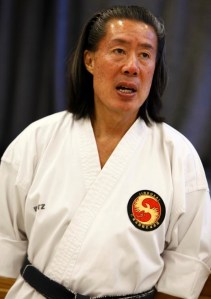
When, a total stranger from far, far away across the world, like Professor Stephen Chan, comes into my life and allows me to grow up under his guidance and tutelage as my Karate teacher, he does so from a position of age advantage, more and higher knowledge and understanding of the ways of the world.
He comes with greater skills, as well as greater and wider appreciation of the Martial Arts, their principles, and history. Through his intellectual and academic might, he has inspired me to want to read, write, and think more about my life and how I fit in the wider game of living as a decent member of society wherever I am at any one time … (Continued in the book: “MACHONA BLOGS – As I See It”. Order Simon Chilembo books on Amazon)
Simon Chilembo
Welkom
South Africa
Tel.: +4792525032
August 24, 2013
WALOBA AWARD 2013

E L W Chilembo, S Chilembo
In memory of my father, Mr Elias Lazarus Waloba Chilembo, I have, under the auspices of my Chilembo Warrior Moves, introduced a special award to recognize outstanding men who in their own unique ways contribute to making this a better world to live for all. Most importantly, these men will be a direct part of my life in things I do and stand for. These men will be sources of inspiration and strength who in their own special ways help me be a better person today than I was yesterday; they will be my teachers, my mentors, my guardian angels, my advisors, my guides, my motivators, my coaches, my brothers, my friends, my family. This is a very personal award, a very personal journey. The recipients will receive a signed diploma as a token of appreciation.
©Simon Chilembo. 2013
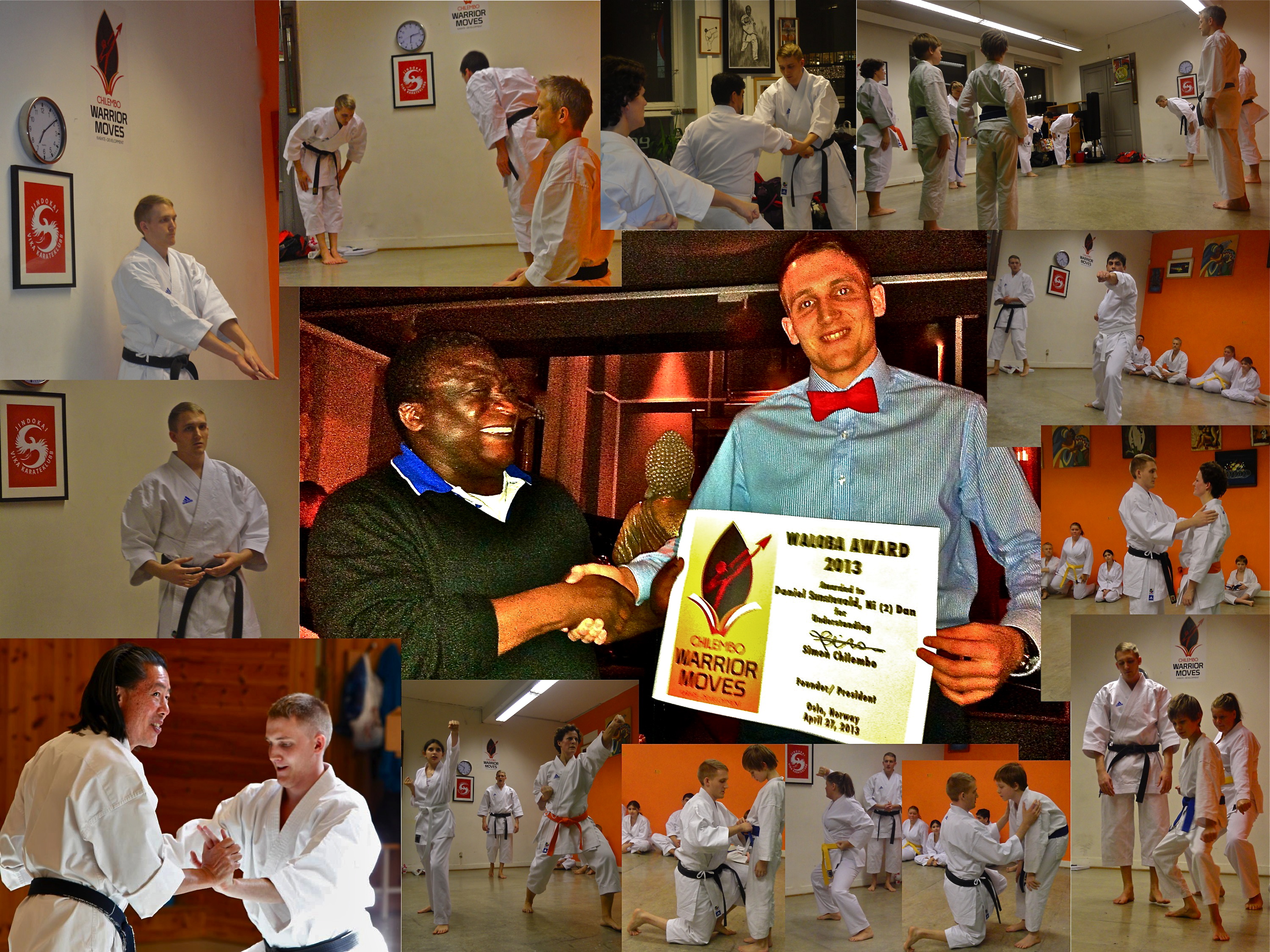
The third recipient of the award (Saturday, April 27, 2013; Oslo, Norway) is Daniel Sønstevold, Ni (2nd) Dan Black Belt, for UNDERSTANDING intricacies of power, leadership, and diplomacy. Despite his young age, Daniel is already a most significant beacon of big-hearted devotion, dedication, loyalty, tolerance, determination, empathy, passion, generousity, compassion, strength, energy, vitality, endurance, resilience, and vision of the future today. I’m proud of, and I feel truly privileged to have Daniel as a part of my life in Norway. The man is Big in South Africa, Big in Japan. I sure want to be like him when I grow up.
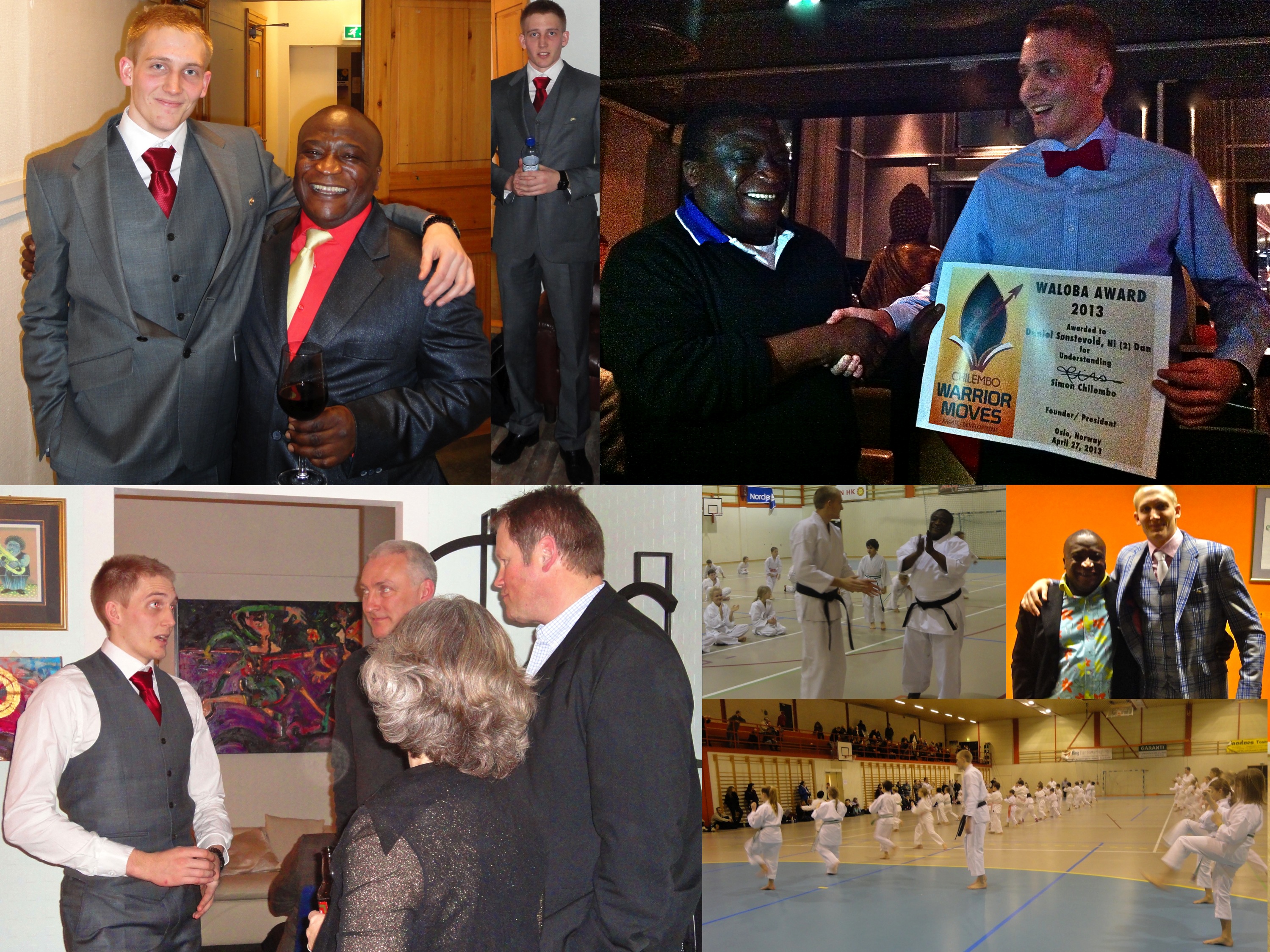
©Simon Chilembo. 2013
On the verge of dying, after a long series of various Ni (2nd) Dan Black Belt grading exercises and routines, Daniel demonstrates a special ability to keep it together, focus, and deliver with dignity and honour, as he goes through his kata; December, 2010, Nesodden:
Simon Chilembo
Oslo
Norway
Tel.: +47 97000466/ +27 717454115 (South Africa)
Mai 08, 2013
 Simon Chilembo