Home » wisdom (Page 5)
Category Archives: wisdom
ONE YEAR LATER: ILLUSIONS IN MY WORLD
REALITY IS I AM HERE, I LIVE, I LOVE, I DANCE.
I AIN’T GOING NOWHERE
“Winter is coming now, Simon. If you have any doubts about coming back to Norway you still have a chance of returning to South Africa, you know,” said Sofia.

“Are you sure you have no regrets about coming back to Norway, Simon? You still have a home in South Africa, not so?” several others remark this way many a time.
I live with no doubts. If I have any doubts, I don’t do it. If I do it anyway and get burned as a result, too bad. What’s done is done. If I die, I die. Closed chapter. If I don’t die, no regrets. I pay the price I have to pay, and move on; assuming that I can still breathe, stand, walk, and think.
If I can think, I can contextualize my feelings. If it feels right to do so because it’s turned out that I’ve really screwed up, I’ll beg for mercy if given a chance to do so. When I’ve been unfairly screwed and the perpetrator is cool about it, exercising their own capacity not to regret unjust screwing up of other souls, I leave them where they are. I never look back. I never go back. I’ll always find new playing spaces.
I’ll always find new playmates. We might play on until our dying days. We might wear each other out in the midst of the golden years of our lives when some shit suddenly happens: somebody gets screwed up somehow, another one bites the dust, whilst the other glosses in new-found glory at the expense of the screwed. It is what it is. That’s how we roll. Falling out of glory is like milk spilling out of a glass. I never cry over either.
Exactly one year ago today, I came back to Norway more shattered than I was when I left for South Africa six years ago. At that time, I watched with dismay as the success empire that I had built came crumbling down. Getting to South Africa soon felt like I had evacuated a sinking ship without any safety equipment to wear or hang on to. Because I’m not a good swimmer, I knew that the only thing I could do was to let go and allow the ocean to take me where it pleased.
If any creature of the oceans came to eat me, I prayed it would be a shark: agile, precise, in perpetual motion straight on ahead. In my naked least-to-no-resistance state of mind in the middle of the waters, I decided to play dead, though. I survived. I marvelled at watching the last vestiges of my extended empire go with the wind to places beyond my fantasy.

By the time my mother died I had been thoroughly humiliated for five years and three months in South Africa. She died a disillusioned mother of a once indomitable son that had come on the verge of falling into the dreaded pit of poverty that is the fate of the vast majority of Black South Africans. On my part, I had long read and understood her despair. I had already long made peace with the fact that her inability to help me to fix my world would slowly but surely kill her. It was not only about me, but my two siblings also. But I had previously been a pillar of strength for the family.
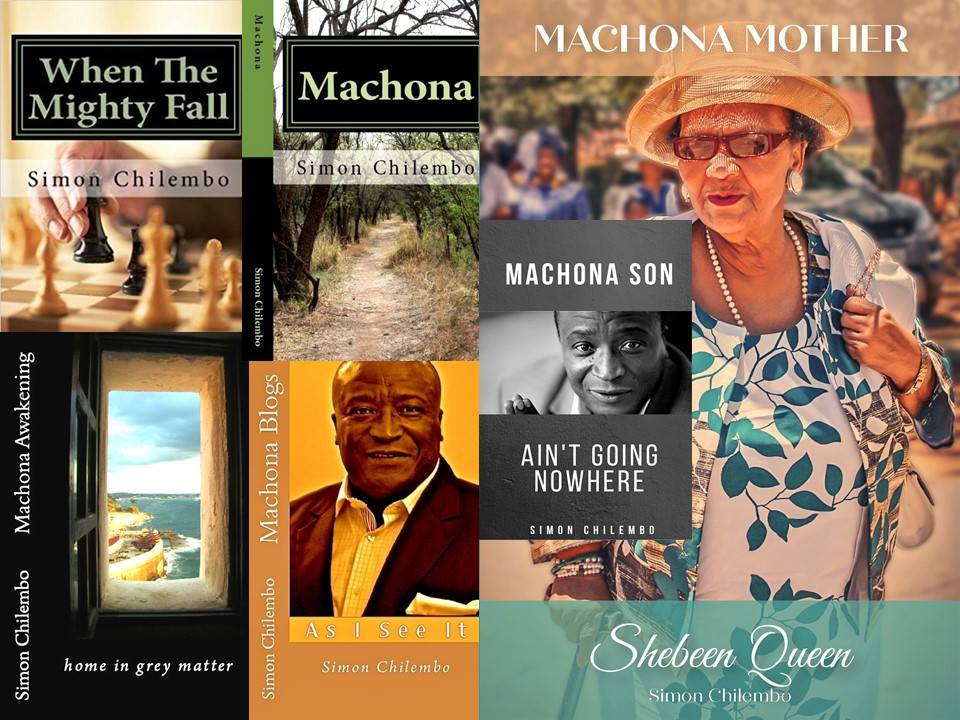
I know that in her old age, my mother’s fear of living in abject poverty ate her soul like cancer did body cells. So, I am convinced that her death released her spirit to a place of lasting peace and abundance. I know that that’s what she aspired to achieve during her life time, anyway. My fourth novel and sixth book, Machona Mother – Shebeen Queen, is inspired by my observation of hers and other mothers’ and wives’ lives in South Africa. Through this I reflect on the challenges of wifehood and parenthood in oppressive societies the world over.
On the eve of my mother’s burial, I was threatened with a bullet in the head. My torment in South Africa had come to a head. I had to leave. Three months earlier, she had in fact finally acknowledged that my future in South Africa was bleak. The only thing she could do was to give me her blessings, and I’d have to find my way back. I should leave whenever I could. She was laid to rest on October 13, 2018.
Eleven days later I landed in Oslo. In grief. Tired. Bankrupt. Homeless. Businessless. Jobless. At total mercy of other people and the state for the first time in my adult life. I received unprecedented overwhelming support and love. This gave me a refreshing new taste of humility in my heart.
Alas, I’m still shocked by the discovery that love has inexplicably diminished, if not vanished altogether in certain quarters. But then again, love is like milk: when it’s spilt it’s gone. No salvage. No cry. Like milk, fresh love abounds. Always. Spilt milk tends to be messy. Post-spillage clean-up is ever so necessary, therefore.
Left unattended to, spilt milk can go stale and stink. Poison. There is a poisonous dark cloud of love lost hanging over my head. Apparently, this cloud is at alarming speed spreading itself throughout the extent of domains that are crucial for my continued existence as a free and happy man of the world.
I now feel that the time has come for me to dissipate the treacherous cloud. Had I lived a hermitic life somewhere oblivious to the real world of real people, I really wouldn’t bother. My imperfections notwithstanding, as an ethically conscious man living in a morally charged world, I have no doubt as to my personal integrity in every step I make every day of my life. It isn’t just about my ego. I respond from a need to protect the honour and legacy of my late parents. Through the latter I reach out to my ancestral spirits throughout the entire Sub-Saharan Africa.
My own legacy matters too. It’s not just about me. It’s all in the name of the living of my people in the afore-mentioned part of the world, particularly my clans in Zambia and South Africa. I have in mind my bosom friends, my godchildren, my teachers, and colleagues all over the world throughout my life’s journey thus far as well. I intend to stay the course until my last breath on earth, which won’t be tomorrow. I’m here for the long haul.
My thoughts also go to all the people the lives of whom I have impacted before, I impact today, and I shall be allowed to impact in the future anywhere in the world: my raison d’être. It is my wish and hope that all the people falling into this broad category shall never feel shame, embarrassment, guilt, or fear at the mention or thoughts of my name, my deeds. My legacy.
I’m proud of my roots. I’m protective of my heritage. I value highly the love and faith of my confidants. I am in awe of the big religious and philosophical thoughts of the world that daily inspire and guide me in my search of liberatory enlightenment in the labyrinth of life. Truth must never shy away from me.
With the poisonous dark cloud of love lost hanging over my head cleared, the following shall be revealed:
- I have been unilaterally charged and convicted without a trial.
- I am not a sexual pervert. I am not a dirty old man. I am not a sexual predator.
- I am not a paedophile. Neither in practice nor by inclination.
- I am not a rapist. I am not into the habit of imposing my sexual power over women. I am not in the habit of taking advantage of sick, weak, and vulnerable women. I am not a sexual manipulator. I am not a philanderer. I shall never engage in sexual intercourse at any price, with anything.
- I love power. But I am not power-hungry. I am not a powermonger. The essence of my being is not defined by the power that I wield as attendant to the things that I do. For example, when I’m revered for being a 6th Dan Black Belt Karate Master, I don’t take it personal. I am nothing more than a conduit between higher knowledge and the people that my position empowers me to serve.
With or without Karate and its inherent existential and functional attributes, I remain the same original Simon Chilembo ever aspiring to be a decent human being each and every day of my life, my fallibilities considered. Karate does not define the essence of my being. It is but one mirror of many that reflect the infinite potential of the essence of me as a human being, a social change force.
I shall never fight for power acquisition and sustenance at any cost. But I shall fight with all of my life against deliberate malicious application of unfairness and injustice as tools and manifestations of power against me, my own, including the values that I stand for. - I am addicted to love and peace.
- It is preposterous to seek to delete my existence in the historical developments of certain phenomena in my worlds. History never forgets. The wise will always query. Answers will have to be given, no matter how murky.
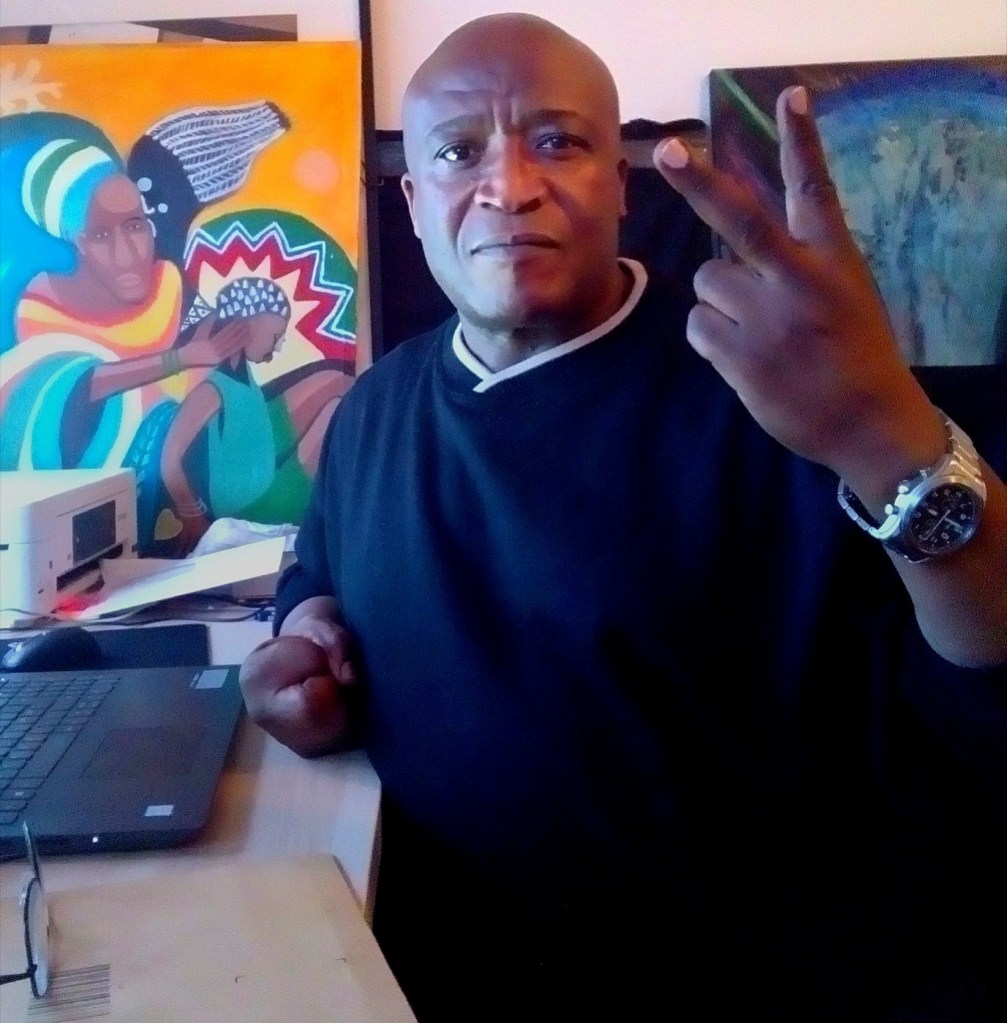
Having stated the above, I encourage anybody with any compelling evidence to contradict me to come forth and present their cases. This evidence shall be tangible, derived from real-life circumstances. It shall not be derived from ill-founded conclusions obtained from subjective misinterpretations of my literary works. It shall not be derived from malicious rumours about me either. Otherwise, people can just lay their weapons down and move on with their lives. We all deserve happily-ever-after living once love has found new hearts to entice. That’s the way of the world.
Character assassination claims and rumours about my person have been doing the rounds in Oslo and environs especially since the publication of my debut novel, When The Mighty Fall, in November, 2015. I feel strongly about these. Such that, in the unlikely event that it can be objectively proved that I am a molester, I will kill myself. That not as a manifestation of any suicidal vice about my character. Moreover, I will consciously choose to kill myself for my sins to save society resources and troubles of arrests, tedious court cases and all that goes with dealing with issues of crimes against humanity. It ought to be as simple as that, really.
I am not a fan of capital punishment. However, my abhorrence of sexual abuse, especially with respect to children, ignites the most primitive of my human instincts. Were I to be found actually guilty in this case, I wouldn’t hesitate to execute upon myself the ultimate punishment that my primitive instincts see as justifiable against child molestation.
I will publicly nail myself on the cross. I will invite the world to come and practice archery on my body until there’ll be no more flesh and bone left for an arrow to pierce. Then my corpse must be set on fire whilst on the cross. No funeral services. No urns. Let the wind blow the devil’s ashes away to places far away into outer space. No memorial services. Denialism of my place in history will be just fine, then: I was never here. I was an accident of nature. I was a figment of my imagination. I was just an illusion.
I say to my enemies all the time: you don’t know me.
Simon Chilembo
Oslo
Norway
Tel.: +47 925 25 032
October 24, 2019
ODE TO ANNE GRETE PREUS
WOMAN OF THE MOON:
It is the 1990s
My decade of
Big books, big love
Big moon, big moves
Big pushes, big rewards
Big visions
Big woman
This big bassline
Of the
Big moon song
Now I know
Limousined me
Through the decade
As if it was born
On January one, 1990
Only for the vehicle
To succumb to
The millennium bug
At time
Zero, zero, zero, zero hours
December 1999
January, year 2000
Splitting the old
From the new
Decade of
Big games, big monies
Big broken hearts
Big losses, big spaces
Of silence after
Big bangs
Big rebirths

I recall seeing her on TV once:
When she was a little girl
Her mother told her to drink milk
So that she’d grow big and strong
She did as implored
Strong she became
Big she became
She became so big
That when the big love
Of the 1990s
Came with moments of
Too big
Too dark to handle
Dark clouds of despair
I looked at her
The big woman
She filled my ears
With her
Big bass line drive
Her voice singing
In praise of the moon
Gave me strength
Gave me hope
I looked forward
To every new full moon
Coming on ahead
Hoping, praying that
This time around
It’s gonna be alright
Alas, the Y2K bug struck
As the big glow of
The 1990s love faded
In spite of
New decade full moon rising
Big love crashed
Pulverized into the
Big river
Of memories
Of sweet moments
Of sweet
Big loving here
Of sweet
Big loving there
That once was
And now she’s gone
The big woman
Big dark clouds of despair
Became a thing of the past
A long time ago
That is how I could
Watch the moon
Full and big
And dream again
The week just gone past
Big moon’s glow lingers on
In my mind’s eye
That is my comfort
To drown my grief
I shall do what she kept
Telling me through her song
During that decade of
My big love
That is history
Of mixed emotions
Today
She said that
Whilst the moon
Hoovers silently
Confident in wisdom
Amongst the stars
People dancing in circles
Looking for life’s answers
On earth
She
Big moon says no word
I too shall become
A pupil of the moon
So that I can
See my pain heal
See my joy
See my love
Return in silence
I shall remain
Pupil of the moon
‘till I see her again
Big woman of the moon
For she knows
Her Highness
The moon
Knows everything
About my world
A tear the size of
Full moon gracing
A star-free night sky
Has just dropped from
The eye above my heart
Jeg er månens elev
I shall cry
And dry
I shall sing
I shall dance
For I know that
If the moon is forever
So is her soul
Love x Love
©Simon Chilembo, 26/ 08- 2019
Oslo
Norway
Telephone: +4792525032
A TITAN IS GONE
REMEMBERING A WARRIOR GRANDMASTER:
JAMES BONAR NOBLE, SENSEI,
DECEASED August 11, 2018.
SPECIAL NOTES
- This is a very personal tribute. It’ll describe a special relationship that I had with Sensei Noble during the years 1978-88.
- I write with the kind of clear conscience that he taught me about. Furthermore, I write with the have-no-fear sense that he instilled in me. I write with the selfless attitude that he demonstrated in working with me individually, and as part of the broader Karate collective in Lusaka. That said,
- I write neither doing anybody a favour, nor expecting any favours from anybody. I write out of the sense of devotion he showered me with. The kind of devotion I have for, and have striven to show to my own Karate students, has been an attempt at replicating Sensei Noble’s Karate-Do spirit.
- I have not had any direct connection, at any level, with Sensei Noble since I left Zambia, in June 1988.
- Situations and events that are necessarily going to be mentioned in this piece are done so to the best extent my memory serves me. Any inaccuracies arising I apologize for in advance. Names of people mentioned are also done so with but only the best of intentions, and respect. If any inaccuracies arise here, or any insinuated malice is detected, they shall not have been intentional on my part. For that, I apologize in advance as well.
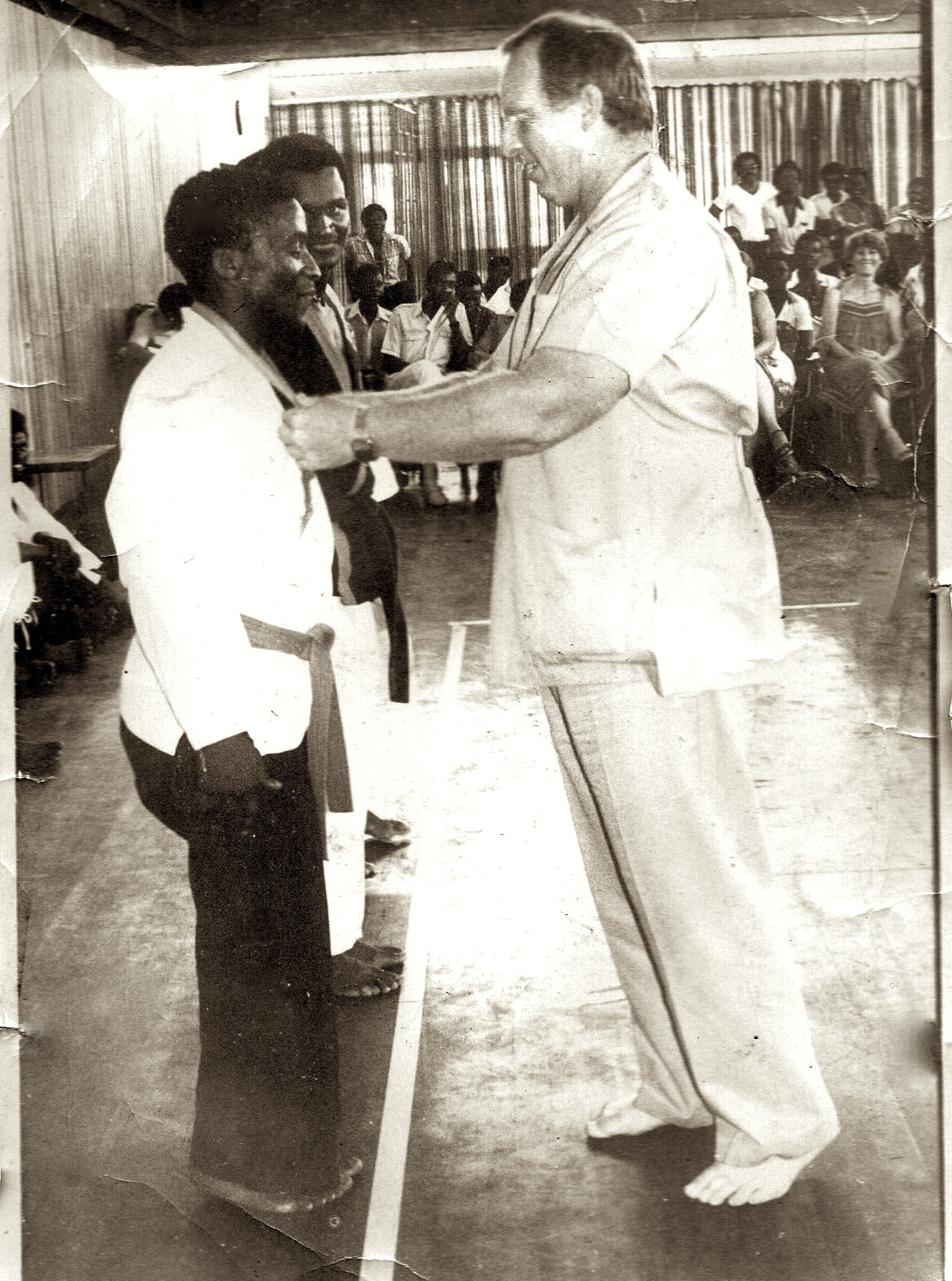
©Simon Chilembo, 2014. JB Noble, Sensei. Wycliffe Mushipi, Sensei, on my left. Presenting Zambian National Kata Champion Gold Medal, 1983. As I flawlessly executed the mid-air rotational flight in Kanku Dai Kata, in the dead still Nakatindi Hall, Lusaka, I thought, “How’s that for flying, Bonar? Your work!”
In 1986-88, my relationship with my fellow senior students of Sensei Stephen Chan is at rock bottom. We were the core group of the recently formed All Zambia Seidokan Karate Kobudo Renmei, headquartered at the University of Zambia (UNZA) Karate Club, in Lusaka. The issues were around mutual misunderstandings vis-à-vis organizational and club leadership roles. They were also around stylistic interpretations, and expressions of our new Karate style, Seidokan.
My biggest sin, though, was to decide to unilaterally take on Zimbabwean, Jimmy Mavenge, late, under my tutelage. I had trained the latter, and subsequently graded him to Sho (1st) Dan Black Belt in Seidokan Zambia Karate. The goal had been that he would, upon his return to his country, take Karate to the people, de-racializing the sport in the country in the process.
I was, inwardly, a devastated man during that time. One day, after briefing my mother about my difficulties with my Seidokan Zambia colleagues, she says, “Why don’t you leave these people, Buti? You cannot fight them alone; there is no need to. You can always form your own club, can’t you? Do that, for your own peace of mind, man!”
“Sure, ‘Ma, forming a new club is not a problem. But, you see, taking them individually, these people aren’t too much trouble, really; they are all driven by group power. However, I still have one person I think I can rely on. That is Sensei Noble. If I have him on my side, then, all these people can go to hell. However, should he side with them, then, I’ll quit.”
Jimmy Mavenge’s rebellious Black Belt grading took place during the middle of the second half of 1987, if I recall. The Seidokan Zambia Black Belts I had invited to witness the event weren’t, of course, willing to be part of the grading panel. That included Sensei Noble. They decided to take up positions on the mezzanine in the UNZA Sports Hall. So, I carried on solo.
In superb fitness state, his former guerrilla mutinous spirit tuned high, Jimmy ran through his gradings’ required routines like a possessed man. He passed with flying colours. Awarding him his diploma, I took my personal black belt off me and passed it onto him.
From the mezzanine, Sensei Noble exploded, throwing his arms up in the air in exasperation, “Did you see that? Did you see what he has just done? Now, it means we cannot annul this grading!”
Before he would turn and walk away, Sensei Nobles’ eyes and mine met ever so briefly. However, I didn’t see the intensity of negative emotion I had expected. His facial expression radiated a sense of wonder that I had seen many times at training with him before. At the same time, it was like he was saying, “Sorry, Semmy, but you are on your own now!”
And, I thought to myself, “Well, this is it, I’ve lost my trusted ally! But I ain’t quitting before my job is done. I owe it to Jimmy to help him make a smooth transition into Zimbabwe. And, I have to use the 1987/ 88 academic year to revamp the UNZA Karate Club (UKC).”
The club had almost collapsed following the squabbles of the senior Black Belts. At some point, only Jimmy and I would turn up for training. When he left for Zimbabwe, a few weeks after the gradings, I was left alone.
I do not recall if I ever did get to have a formal position in the then Zambia Karate Federation (ZKF) Board of Directors cabal. But I got to coach the Zambia Midlands Karate Team in 1986-88. That meant that, although the Zambia Seidokan deliberately excluded me from certain events, Sensei Noble and I would often meet in connection with our ZKF work. The Sensei was the active patron of the ZKF, then. In the ZKF domain, our relationship was as amicable as ever.
I shall take the writer’s prerogative and postulate that I have sat 10 000 miles with Sensei Noble in his car; all in ZKA related training and administration matters in Lusaka, and between Lusaka and Kitwe, in the Copperbelt Province. That would also include a trip to Harare, together with the Zambia National Karate Team, in 1981.
Sensei-Student bonding does not take place on the training floor. In the dojo, the Sensei and his students just want to kill each other, whilst, at the same time, the former’s job is to constantly remind the latter that “life is good, people. Love it, preserve it!”
Although I had no idea of it at that time, my Sensei-Student bonding with Sensei Noble took place in those 10 000 miles I’ve sat with him in his car.
“You have upset many people, Semmy. Stephen Chan Sensei is not happy with you at all. You have infringed upon Sensei Chiba’s territory. No good, no good at all, Semmy!” Sensei Noble said to me during one of our trips. This was sometime in early 1988, about six months after the Jimmy Mavenge gradings scandal. By then, I had already been to Harare to check on his progress.
I responded, “I’m well aware of that by now, Sensei. That withstanding, the work that Jimmy has already done since he got back home is amazing. It’s one of those occurrences that, to be believed, they have to be witnessed personally. I’m, now, even more convinced that we did the right thing.”
I went on to explain how Jimmy had started to train children and youth at Harare’s Mbare township, where the not so fortunate people lived. He had also started to teach Karate at an orphanage run by a close friend of his. All for free. On the other hand, Sensei Chiba ran a private dojo in the city centre, catering for the paying middle class, predominantly white. Efforts to reach out and pay a courtesy call to the senior Japanese sensei had been futile.
“Alright, Semmy Sensei, I will give you that one. But the others don’t know what you have just told me. We have to do something about this, then.”
I’m not quite sure now, but I have a vague recollection that, not long after I had left Zambia for Norway, Sensei Noble did drive out to Harare to check on Jimmy. On the trip, he had taken along one of my absolute meanest detractors. The rest is history.
While giving him the report on Jimmy, what I did not tell Sensei Noble was that my work with the former was, in a large measure, influenced by his off-the-mat teachings.
Sometime in the first half of 1979, tensions at our former Trinity Karate Club had become extreme. A point had been reached where either Sensei Noble or the bunch of new young lions Sensei had to go. If I recall, it was after the last training session that he would lead at the club, that he offered to drive me home to Chelston. The latter is nearly 20km on the opposite part of the city, in relation to his residence at the Andrews Motel, about the same distance away from the mentioned reference point
“You see, Semmy, everybody wants to lead. But people don’t realize that leadership is something you grow into. I’m really not sure if those guys are ready to lead the club. However, they want it, so they can have it. My conscience is clear, I have taught them only the best of Karate available in the country, if not all of Africa. If they now feel they know more than I do, fine by me. They’ll soon find out that real Karate is not found in books. Books guide. They don’t teach. Lasting knowledge is learned man-to-man,” Sensei Noble said.
He continued, “People don’t know that I have nothing to prove. I have no need to want to prove anything. Do these guys want me to break their bones to prove that I am stronger than them? Do they want me to jump and fly like a teenager to prove that I am a good Karateka? Rubbish, if you ask me!”
The Sensei was in his forties at this time.

©SIMON CHILEMBO, 2014. FLYING TO KATA CHAMPION GOLD MEDAL, 1983. AS I FLAWLESSLY EXECUTED THE MID-AIR ROTATIONAL FLIGHT IN KANKU DAI KATA, IN THE DEAD STILL NAKATINDI HALL, LUSAKA, I THOUGHT, “HOW’S THAT FOR FLYING, BONAR? YOUR WORK!”
With his left hand, pointing at his head, and tapping on his left side of the chest, Sensei Noble went on, “The point is, Semmy, I have it all in here. I can’t fly, and I have no desire to, so you know. But I can teach you how to fly. By the way, as from this coming Sunday, and subsequent ones, until further notice, I’ll be teaching special classes to interested Brown Belts and above. That’ll be at the Evelyn Hone College. We start at 9 o’clock. Feel free to join us.”
“Oh, thank you, Sensei, I’ll be there. Of course!”
“I know that public transport is a problem on Sundays. So, don’t worry, I’ll come and pick you up. And, do, please tell your parents that I’ll bring you back home safe afterwards, okay?”
“Yes, Sensei, thank you! You are very kind.”
“A sensei is like a father, Semmy. When you are good, he’ll be good to you. Always remember that!”
“Hoss, Sensei!”
One year later, Trinity Karate Club was in such leadership crisis that it had to close down.
Indeed, my work with Jimmy was a well thought out venture. I did it with love. I believed in the man and the cause he pursued, in that regard. My conscience was clear: I had no pecuniary, nor power interests; I was simply doing what my heart told me was right; I believed I had acquired sufficient knowledge to empower Jimmy to shake up the then racist Zimbabwean Karate establishment, and it worked; although I felt no need to prove it, I knew that I was strong and skilful enough to give anybody a good fight should the situation degenerate to that level. I would have been just too happy to break an enemy’s bone or two, actually. All this I had learnt from Sensei Noble’s way of Karate.
I do not recall how long the Sunday morning training sessions lasted, but it was many, many Sundays. True to his word, Sensei Noble would come and pick me up from, and take me back home. No complaints. No demands. Just training. I used to find it strange that this man, who also taught children at the Lusaka International School on Saturdays, did not take even a Sunday off in order to be with his own children and wife.
More than twenty years later, Martin Rice, a very special, Sensei Noble’s younger protégé from Ireland, is visiting us in Norway. Naturally, we begin to talk about our experiences with the legend. I mention the Sunday sessions, and the lengths to which our grand Sensei went to accommodate me.
“But, Simon, on those Sundays, after dropping you off at your home, he would, then, come home to me for another two hours of private lessons!”
Sensei Noble’s devotion to the Zambian Karate community that he raised single-handedly, at least in the Midlands, up until the 1980s, has made a lasting impression on me. That he even had the extra capacity to work with the select few of us in the manner that he did touches the softest of my emotions to this day.
There has been a time I asked Sensei about his level of engagement in Karate. He replied, “Well, Semmy, funny that you should ask. You know, once the spirit of Karate gets into you, it consumes you. But, each time you see the good things Karate does for people, and, by extension, society, you can’t stop it. You can’t live Karate half way. You can’t teach Karate halfway. People will come and go. But you have to be there all the time. One day, a student of your calibre, Semmy, walks into the dojo, and you, then, know that there is no way you can let this talent down. And, so, you just give and give. It’s such a joy, Semmy. My family understands that Karate is an important part of my life.”
Back in Zimbabwe on a normal civil servant’s salary, Jimmy no longer had the kind of cash he used to have whilst on his diplomatic tour of duty in Lusaka. He couldn’t afford to pay for my visits to him. I visited him twice during the first half of 1988.
In his humorous way, Jimmy had a brilliant idea, “Shamwari Sensei, you mean after all these years together you haven’t learnt even just a bit of diplomacy from me? Soften yourself, be nice, go down on your knees and ask the Seidokan Zambia people to sponsor your trips here. We have already crossed the Zambezi, anyway, and Seidokan Zimbabwe is here to stay. So, they better work together with us now!”
I had already started to make my own money then, “No, no, no, Shamwari Sempai, Senseis sponsor themselves and their students, you see!”
Through working with Sensei Noble, I learned that a Sensei must be self-sufficient. A Sensei that depends on sponsorships and donations cannot do his work effectively.
On a drive from Kitwe to Lusaka, Sensei Noble is cruising at between 140-150km/ hr. A Mercedes Benz overtakes us like it was a bullet, and soon disappears from our sight up ahead. Perhaps 15 minutes later, we approach a road accident spot. The Merc had overturned. It had rolled several times, apparently. Totally wrecked.
“Yes, that’s what you get when you drive at a speed like that on roads like these, Semmy. Karate teaches us to always be aware of our surroundings in relation to the actions we wish to undertake. From that, we can calculate and predict likely outcomes. I knew that that car wouldn’t reach Lusaka, driving at that speed,” Sensei Noble spoke wryly as he drove past the accident scene. We would learn later that the driver of the Merc had died on the spot.
The grand Sensei has told me that when he first came to Zambia in the early 1950s, he had only the amount of pocket money a fresh university graduate from Scotland would have in those days. Not much. He landed somewhere in northern Zambia, somewhere around Lake Bangweulu, if I’m not mistaken. To pay for his hotel stay there, he offered to hunt game for the establishment. That’s how he started off in Zambia, a place he had come to with no intentions of living in permanently.
From that experience, he has said something like, “You see, Semmy, as you get older, and you start travelling the world, you’ll soon discover that there is more to you than who you think you are: your race, status, education, and the like. You’ll find that you get to places where none of that counts. So, in order to survive, you have to look for solutions in things that you never even knew about before. That’s how a Karate man’s mind works. Just like people fight differently, you can beat anybody with the same techniques, but adapting them to the kind of man attacking you. That’s how life is, the essence of you does not change, but your attitudes can, and have to, according to where you are, and the circumstances you find yourself in.”
I applied that Sensei Noble’s philosophy in Norway. Whilst in a place I was not supposed to be, for an act I was not supposed to commit, a colleague saw through me, “You Simon, I know your type. You are a survivor. Don’t tell me that you are a Massage Therapist because that’s a career path you had planned all along. I know you are good at what you do, but you chose to study Massage Therapy out of survival pragmatism needs, given your life circumstances in Norway. You are cut out for greater things, and I know you know that!”
Yes, Sir, I do. But until the greater things come my way, I’ll do what I gotta do to survive here and now, as per my Sensei Noble’s teachings.
Whilst in Harare with the 8-man Zambian National Karate Team, in 1981, I was singled out to join Sensei Noble as he joined two other Zimbabwean senior Black belts (whites) to tea at the home of a Japanese diplomat. I do not remember the name of the diplomat. Present were also the dreaded Sensei Chiba, and two other Japanese Judo Sensei. I was a not so sophisticated, little 20 year old schoolboy, then. But the grown up, senior Budo masters were real nice to me. I recall Sensei Chiba advising me to use whatever nature provides to train with, if I cannot go to the gym. “If you do not have a punch bag, there is always a tree to punch!” he said.
Driving back to our hotel, Sensei Noble said, “You were highly honoured today, Semmy. High-ranking Japanese don’t just invite any strangers into their homes.”
“Hoss, Sensei!” was all I could say.
An aspect that is not spoken much about is that, in his pioneering work of opening up possibilities and teaching black Zambians Karate from the late 1960s, Sensei Noble was, actually, treading on thin ice. That’s because, in my view, that was a time of numerous state coup d’états across the African tropics countries. White mercenaries, whom the media romanticised as Martial Arts experts, led many of these coups. “Mad Mike” Hoare is the first name that comes to mind here. A reliable source has disclosed to me that there were concerns that some of Sensei Noble’s Karate students could be enticed to join the lucrative (for those who don’t die!) mercenary bandwagon. So, relevant Zambian State Security organs closely watched him, and the whole lot of his prominent senior students.
I am sure that there are many others in the Zambian Karate fraternity who’d concur with me that Sensei James Bonar Noble gave us, individuals, and the collective much more than we could ever ask for. He, like other ordinary mortals, was not perfect. I, for one, am not in a position to cast any stones. Unfortunately, by the time the roses in my garden bloom in the spring, I’ll have relocated to another abode.
My heart felt condolences to the Noble family in Lusaka. The same applies to the Zambian Karate fraternity, if not the nation, for the coming to an end of a life of an illustrious service to the people through the Martial Arts. Many of Sensei Noble’s students and their own protégés continue to tread upon the selfless path of humility, giving, and devotion that he started. Their impact is felt across the cross-section of the Zambian society. Some are also forces to reckon with in various parts of the world.
Sensei James Bonar Noble may be gone, but he shall never be forgotten. His legacy is just too deeply engrained in the psyches of many of us. May his soul rest in eternal peace!
Simon Chilembo
Welkom
South Africa
Telephone: +4792525032
August 13, 2018
STORY OF MOTHERS AND WIVES
WHAT MOTHERS AND WIVES DO
The little I know about my mother’s life inspires my forthcoming fourth novel, which will be my sixth book. As I progress with the work, I get to appreciate more and more that a wife and mother will do what they have to do for the good of their children and the honour of their husbands. At the same time, wives and mothers are also made of flesh and blood; they are human too, just like everyone else.
They shall slip and fall, gather dirt like everyone else. They shall rise, shake themselves from the dust, and fail to erase the stains; just like everyone else. If the good they did for their children, and the honour they bestowed their husbands is greater than the outcomes of their fallibilities, then, who is anybody to judge?
 ODE TO WINNIE MANDELA:
Courage personified
Defiance personified
Endurance personified
Grace personified
Humanity personified
Inspiration personified
Longevity personified
Loyalty personified
Mystique personified
Resurrection personified
Motherhood dignified
Phum’la ka kuhle, Mamma
Should they seek
To blow out
The torch of your legacy
I will be there
They’ll have to first
Take me out
A luta continua
For the love of Mothers
Amandla ngawethu!!!
SIMON CHILEMBO
RIBEECKSTAD
WELKOM
SOUTH AFRICA
APRIL 13, 2018
TEL.: +4792525032
MANDELA, KAUNDA LEGACIES
Unilateral Tug of War
Just in terms of numbers, South Africa and Zambia cannot be equated. Of course. The former outstrips the latter by far: from territorial boundaries dimensions, population sizes and overall demographics, natural resources endowment, optimal economic potential and actual performance, to military power. Numbers don’t lie.
It goes without saying, therefore, that at any one time, any one variable or all highlighted above considered, South Africa will, in real terms, be a much more complex society relative to Zambia. Meaning that politics in South Africa will, correspondingly, be a more challenging enterprise for those involved in the national political leadership arena, whether in ruling power or in the opposition.
Needless to say that there are, indeed, countries smaller than even Zambia, but happen to have much more intricate political intrigues than South Africa. Another time and another place for the last observation raised.
A simple Google search will either confirm or debunk my assertions above, much as it will do with many of my postulations throughout this presentation.
Politics is the science of government. Government is the collective of institutions, including their constituent leaderships and functional personnel. They are created to enforce societal progress rules and policies that are arrived upon by the representatives of the body politic.
The government, or the state, will often reflect the interests of the dominant political parties. However, through corruption and greed, the dominant, ruling political parties may themselves be subtly steered by peripheral influential, manipulative economic forces. These may either be local or international actors, if not a combination of both. In South Africa, the concept called “State Capture” describes the collusion between the powerful economic elite and the government.
Notwithstanding the “State Capture” phenomenon, the interests of the respective political parties are often shaped and differentiated by their cardinal ideologies. An ideology is the summation of ideas based on theories and policies of political and economic engineering of society.
Ideologies are applied in varying ways to indoctrinate particular societies to address and find solutions to existential questions and challenges in certain pre-determined, and non-variable methods. Therefore, ideologies are not only critical for shaping individual countries’ internal living conditions, they also influence individual countries’ international relations premises; i.e. which countries will have mutually cordial diplomatic relations with one another, which supranational institutions the countries will be members of, which international solidarity causes countries will engage in and at what cost, etc.
In contemporary times, historical factors leading to the creation of specific nations often contribute to the kind of ideology adopted, developed, or redefined to suit local conditions. A nation’s wealth, often with particular reference to its relative strategic significance to the major economic and political nations and power blocs in the world, will also have a bearing on the nature of the dominant ideology. A subservient country’s geographical location on the globe can further add to, or reduce its strategic value.
At any one time, a quick reality check will show that relatively newer and smaller nations with both perceived and real strategic importance to the major political and economic giant nations, e.g. the industrialized Western world, have a hard time determining their own, sovereign national ideologies.
Old ties bind some of these emergent states with their former colonial masters from the Western world. Others will be held in infinite indebtedness to comrade states from the Eastern socialist, or communistic countries that helped in their liberation struggles for independence.
It is in the light of all the above that I choose to look at the comparative legacies of Nelson Mandela of South Africa, and Kenneth Kaunda of Zambia. Comparative because of the many critics of Nelson Mandela, who, in my view is unfairly battered in relation to the critics’ view of to whom real Southern African statesmanship ought to be accorded contra Kenneth Kaunda’s legacy too. I specifically address myself to Zambian critics.

Nelson Mandela attends the lieing in state of ANC president OR Tambo at FNB stadium, Soweto, South Africa. (Greg Marinovich)
Before I proceed, I wish to make a few salient personal points:
- I must declare that this is a non-solicited presentation. It is only an outcome of the involuntary workings of my critical thinking mind and its creative processes. It is my subjective, free world intellectual response to the foul anti-Mandela vis-à-vis Kaunda sentiments I have seen expressed in the various social media platforms, particularly Facebook, for many years. It is not my goal to want to be malicious against anybody. Neither is it my intention to seek or expect approval, favours, or rewards from anybody.
This is an honest, independent expression of my thoughts and feelings with nothing but the very best of intentions. All this is done with the utmost respect both for Mandela and Kaunda, their respective families, and their followers through their respective foundations and other fora … (Continued in the book: “MACHONA BLOGS – As I See It”. Order Simon Chilembo books on Amazon)
Simon Chilembo
Welkom
South Africa
Tel.: +4792525032
February 13, 2018
GOD IN MAN
SCIENTIFIC MAN OF GOD
Epigenetic inheritance theory has captured my fascination in a profound way. It has cast new insight into how I now think about the nature of man. That with reference to how I relate to man in the spontaneous, continuous process of writing and playing my own story as I go through the labyrinth of life. Some call it legacy.

©Simon Chilembo 2017
But I don’t really care much about “the legacy I shall leave behind”. If I do have a legacy, it has, actually, built, and shall sustain itself for as long as time wants it alive. Nevertheless, immortality is the goal. Who wants to live forever? I do. Why not?
All I care about is the integrity of the authoring of my life story lines as I dance my way through to my exit point of the maze that far, far away.
My hope is that my life story shall be read and judged with open, scientific minds, both whilst I still walk the face of the earth, and when I’m dead.
Thanks to epigenetic inheritance theory, I have finally seen the light: yes, the human body is, indeed, a temple of God. By extension, any other creature that subscribes to, and lives according to tenets of any prescribed faith, has its physical body as the temple of God; at least in the Western world’s perception of the Deity.
Even more precisely, the philosophical duality of God and her anti-thesis, Satan, is not only a construct of the core of man’s existential questions’ thinking: their abodes, heaven and hell, respectively, are, in fact, in the DNA of man.
There is no place called heaven outside the realm of man’s existence on earth. Neither is there a place called hell in the same illusory domain. Heavenly rewards, or satanic retributions for our virtues and sins, respectively, we live them accordingly right here on earth. When we die, we are dead: our DNAs have switched off from our consciousness, and so have the ideas of God, Satan, heaven, and hell.
It is only the unenlightened that fuss about life after death for the deceased. The human soul leaving the dead is as real, as independent, and as infinite as the universe. So, leave it alone. It knows how to take care of itself. Ever heard of a buried soul? They failed to bury Jesus.
It ought to make perfect sense that life-after-death is, indeed, a reality for the living only. Life goes on. But, living in the dark, and confronted with challenges of life with nature, the survivors seek answers outside of themselves. Finding no workable solutions out there, panic grips them. Fear of the unknown rules over their lives through and through … (Continued in the book: “MACHONA BLOGS – As I See It”. Order Simon Chilembo books on Amazon)
Simon Chilembo
Welkom
South Africa
Telephone: +27813185271
December 19, 2017
ZIMBABWEAN PSYCHOPATHS IN SOUTH AFRICA
HUMILITY NEVER HURTS
Because I’m, in this posting, addressing myself to psychopaths, I’m going to be linear in my thought expression. I’m going to deliberately make non-substantiated claims. I am not opening a discussion. I only need to let my frustration out. That is because I need to breathe, so that I can continue enjoying the made-to-last freedom and peace of my motherland, South Africa.

Simon Chilembo, Author/ President/ Machona-Emigrant
But, that does not mean that those strongly wishing to respond are prevented from doing so. There is one condition I demand to be fulfilled, though: substantiation and logically structured, mature presentation of opinions, agreeing with me or not. I shall not tolerate personal attacks and insults. If necessary, I’ll only engage with those whose views I regard to reflect a respectable degree of wisdom and intellectual sophistication, if not substance.
Psychopaths have no sense of right or wrong. Psychopaths have only one view of the world. Psychopaths see and interpret the universe only according to how their faultily wired perceptive and analytical senses relate to impulses emanating from their immediate and distant ecologies. Psychopaths lack empathy.
A fifty-six year old man progressively screws and holds his own country and people to ransom for thirty-seven years. Because he is a psychopath, Mugabe holds on to power even in senility. Wasted at age ninety-three, he continues clinging on to the no longer functional national presidency; totally oblivious to the real danger he personally, not to mention the almost 16.5 million people of Zimbabwe, is, are exposed to. That after a rather long overdue but, thank goodness, well-orchestrated military coup.
The Zimbabwean military intentionally chose not to assassinate Mugabe because of the non-psychopathic nature of the key generals and others involved in the coup, and his subsequent peacefully coerced resignation from power two weeks later. However, in their psychopathic minds, Mugabe and his like-minded have no comprehension of this fact.
Mugabe is finished. Mugabe is a lost cause. It is not worth wasting any more of my little breath left on him. I want to, now, address myself to the 5 million Zimbabweans who escaped from Mugabe’s tyranny to find protection in South Africa. 5 million is the whole population of a country – Norway, for example.
Other common and non-mistakable traits of psychopaths are acute arrogance, lack of respect, and ingratitude towards others, especially the generous, kind, and tolerant. (Originally) utterly desperate refugees from war torn Middle Eastern countries, and beyond, encounter rapidly growing hostilities from ordinary citizens in their Western Europe host countries.
The refugees do not understand how their religious and cultural chauvinism continually feed their hosts’ ill will. They are incapable of appreciating challenges around their own lack of willingness to change and adapt to the dynamics of their new environment. They are psychopaths. Thanks to them, the ultra-right wing wave keeps growing across Europe. Thanks to them, we now have Donald Trump as the most powerful man on earth.
In South Africa, there are Zimbabwean psychopaths who manifest exactly the same tendencies as above. Zimbabwean psychopaths in South Africa go around the country enjoying the very best freedoms and democratic rights no other African country can equal. Yet, the mentally deranged Zimbabweans behave so dishonourably towards their South African hosts it’s disgusting. And, then, naturally, they do not understand where the so-called Afro-phobia violence in the country comes from. Sickening to the core … (Continued in the book: “MACHONA BLOGS – As I See It”. Order Simon Chilembo books on Amazon)
Simon Chilembo
Welkom
South Africa
Telephone: +4792525032
November 26, 2017
FARM MURDERS
SOUTH AFRICAN FARM KILLINGS: Another Perspective
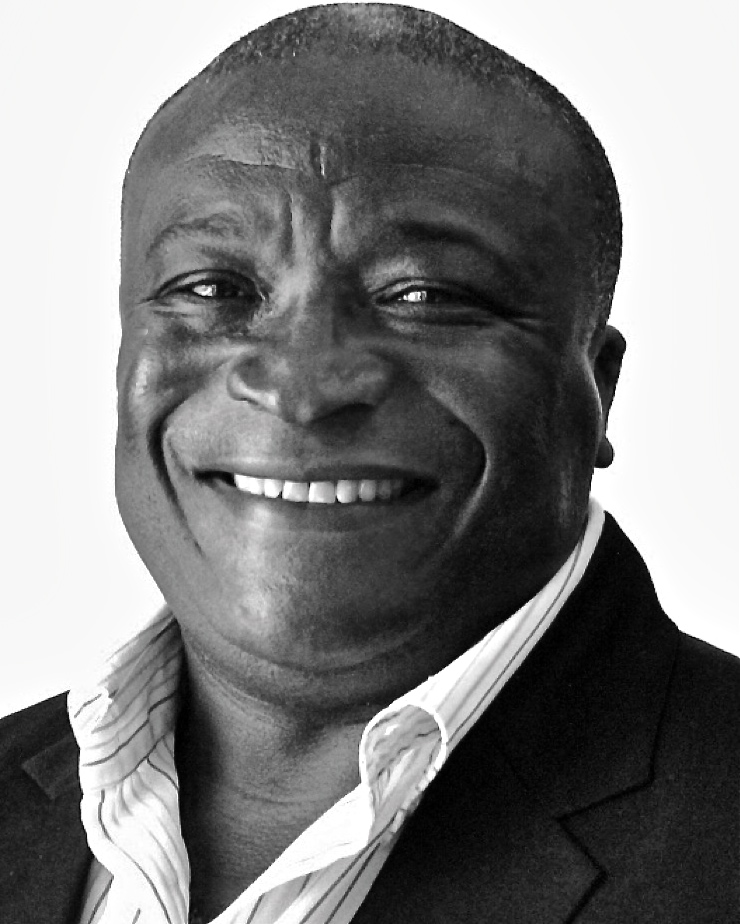
©Simon Chilembo 2017
I do not condone murder of any kind. Murder is murder, regardless of how it is classified on various platforms. No murder is worse or better than another. In the free world, we are all humans with infinite variable attributes, but equal in the face of the law of the land.
In the purest manifestation of God, we are all supposed to be equal because she created us that way, in her own perfect image.
Whilst I do not condone murder, left with no alternatives against any real, particularly unjustifiable, threat upon my life, or that of my beloved ones, including my lands, I could kill without thinking twice about it. In my world, there is no “turn the other cheek” contra injustice and evil intentions, or practices. If evil plucks out one of my eyes, I’ll pluck both of theirs, and more. It is what it is.
If I am a racist, it is more a circumstantially reactive tendency on my part, rather than it being an inherent disposition of mine. I hate racism with such passion I cannot help but want to give racists a taste of their own medicine whenever I encounter them in South Africa, and anywhere else in the world I find myself at any time; two eyes for an eye. Reconciliation modern South Africa style has its limits for me.
In characteristic, yet another demonstration of arrogance of power and privilege, a section of the white South African populace sensationalizes the killings of South African white farmers. As if these killings are a calculated, lopsided affair sponsored by the South African state, or some other organized, black peoples special interest entities.
As a humanist, whenever death strikes anywhere in the world, my heart ever goes out to the deceased and their bereaved families. The killing of a white South African farmer is no different from any other killing in the country, or anywhere else in the world. Therefore, I cannot feel relatively any more, or less empathy for the white South African farmer victims and their own … (Continued in the book: “MACHONA BLOGS – As I See It”. Order Simon Chilembo books on Amazon)
Simon Chilembo
Riebeeckstad
Welkom
South Africa
November 08, 2017
A FATHER IS GONE
REMEMBERING A SENIOR WARRIOR:
SVEIN SØRLIE
It is almost two weeks since Svein Sørlie died on Tuesday, August 15, 2017 in Norway. He shall be buried on Tuesday, August 29, 2017. I believe that wherever his soul is in the grander universe, it is thriving in the best conditions of the afterlife; resting in peace, hopefully. There is no rest for the hearts of gold. Gold is forever; larger than life. Such was Svein Sørlie as I knew him, feeling as if it had been all my life.
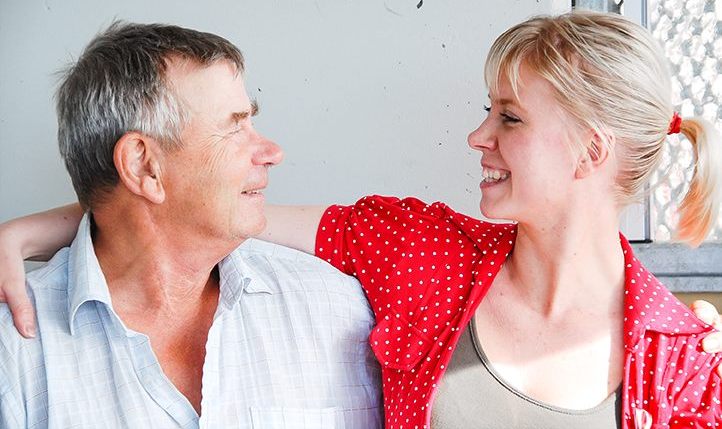
©Toril Sørlie 2017
Svein Sørlie: my student, my friend, my mentor, my protector. In time, he grew to represent a formidable father figure for me as I strove to curve a space of my own in a land that is not of my forefathers, Norway. With his death, it feels like a large chunk of Norway has just been ripped off my heart. The hurt I feel is profound.
I have known Svein, since March, 1989. During much of this time, I’ve watched with awe how he would ever so elegantly balance, sometimes in one and the same space, the role of a father, grandfather, brother, uncle, lover, in-law, friend, teacher, student, colleague, citizen, and community member. I could never get enough of the warmth and love that, on the one hand, Svein exuded, and received, on the other.
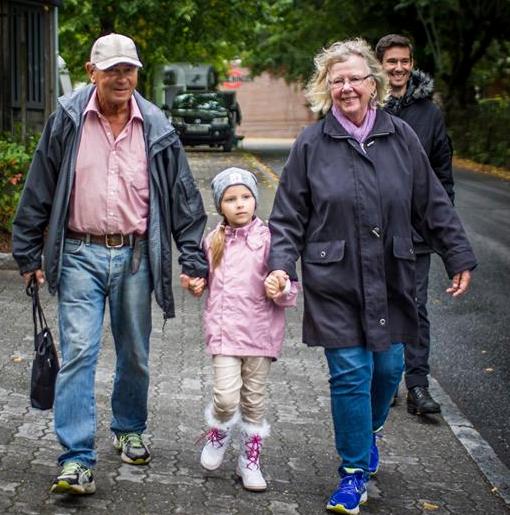
©Toril Sørlie 2017
It did not matter whether we were in Norway, or travelling in Greece or the UK; he was ever so easy to get along with. I guess it had to do with the aura of humility and compassion he radiated, long before he would open his mouth to greet people, and introduce himself to strangers.
Winter, spring, summer, or fall; dojo, camping, competitions, seminars, party, home, city centre, beach, everywhere: Svein Sørlie was the ever green, the ever wonderful. An IT expert, a former naval officer, and Judo adept, he was a knowledgeable and wise man; a man of the world. His terrific sense of humour made it a joy to talk with him about many subjects of common interest, any time.
On Wednesday, March 29, 1989, Anne-Britt Nilsen helped me arrange and host a public meeting to introduce Karate in the local community of Blåbærstien, Nesoddtangen. I was accompanied by my first ever Norwegian Karate student, Knut Arild Midtbø, who I had already started to train in Oslo since October, 1988. He would translate my message, since I hardly spoke a word of Norwegian, then.
In a packed, rather small community hall, the reception we received was mixture of curiosity, enthusiasm, scepticism, and outright hostility. During an altercation between my assistant, Knut, and a man who was totally against our mission in his neighbourhood, my eyes fell on a bespectacled older man. A little girl was sitting and playing at his feet. As our eyes met, the man gave me a gentle, reassuring smile; I thought the look on his face told me something like, “Never mind him!”
The friendly man was Svein Sørlie, and the little girl was his youngest child and daughter, Toril. For the next ten years or so, the Svein-Toril family duo would be the heart-beat of Blåbærstien Karate Klubb, now Nesodden Karateklubb. It was such that at a time when I had to make one of the most decisive choices in my life, I weighed my options against, amongst others, the joint pillar of strength Svein and Toril jointly represented for me in the club, if not the country Norway … (Continued in the book: “MACHONA BLOGS – As I See It”. Order Simon Chilembo books on Amazon)
Simon Chilembo
Welkom
South Africa
Telephone: +4792525032
August 28, 2017
A DECADE LATER
GROWING UP IN TEN YEARS
It is not as if much has changed since I entered the afternoon phase of my life. In my younger, less restrained rock and roll days, going out to a party meant, amongst others, getting told that I talked too much, too loud. Getting laid would also come as a matter of course, although not necessarily as a must; just a cool endeavour to engage in to seal yet another successful party night out.

©Simon Chilembo, Author, President 2017
On the afternoon of Friday, July 27, 2007, I embarked on a cross-border trip from Oslo, Norway, into Sweden. The destination was a recreational cottage village on the outskirts of the south-western city of Gothenburg. I know now that I really had not been keen on doing that trip. But I had to: duty called; business. I was exhausted after a hectic two weeks’ business tour across much of South Africa, from which I had arrived in Oslo the previous day.
There was also a distant, yet distinct enough, uneasy feeling about the double-events calling for the visit: a business partner’s birthday celebration on the day. The following day, July 28, it was scheduled the inaugural shareholders’ meeting for our newly-registered trading company.
I had had a theoretically substantiated notion that, despite the negative vibe I felt, everything would end up well. I couldn’t help but see the millions of dollars we were going to make as we went on to transform and dominate the Scandinavian health foods market.
On my part, I already saw how I’d use my share of the millions to help even more of my needy South African relatives’ children acquire decent education. The poverty levels of some of these people sear my heart ever so too much for comfort on any day.
Apart from a few new dark suits, a new Mercedes, and a new apartment in Oslo, I really had no reason to blow the monies on any more of my vanity needs. I already had my gold Rolex. So, I was cool.
As, on the morning of Saturday, July 28, 2007, I found myself driving my former business partner’s car on some unfamiliar country road, I immediately understood that something terribly wrong had happened. I wanted to believe that I was seeing myself in a nightmare, up until an almost frontal collision with an oncoming vehicle. Things had terribly gone wrong, alright. But, how? … (Continued in the book: “MACHONA BLOGS – As I See It”. Order Simon Chilembo books on Amazon)
Simon Chilembo
Welkom
South Africa
July 24, 2017
►Order Simon Chilembo books here.
 Simon Chilembo