Home » Articles posted by Simon Chilembo (Page 9)
Author Archives: Simon Chilembo
MANDELA, KAUNDA LEGACIES
Unilateral Tug of War
Just in terms of numbers, South Africa and Zambia cannot be equated. Of course. The former outstrips the latter by far: from territorial boundaries dimensions, population sizes and overall demographics, natural resources endowment, optimal economic potential and actual performance, to military power. Numbers don’t lie.
It goes without saying, therefore, that at any one time, any one variable or all highlighted above considered, South Africa will, in real terms, be a much more complex society relative to Zambia. Meaning that politics in South Africa will, correspondingly, be a more challenging enterprise for those involved in the national political leadership arena, whether in ruling power or in the opposition.
Needless to say that there are, indeed, countries smaller than even Zambia, but happen to have much more intricate political intrigues than South Africa. Another time and another place for the last observation raised.
A simple Google search will either confirm or debunk my assertions above, much as it will do with many of my postulations throughout this presentation.
Politics is the science of government. Government is the collective of institutions, including their constituent leaderships and functional personnel. They are created to enforce societal progress rules and policies that are arrived upon by the representatives of the body politic.
The government, or the state, will often reflect the interests of the dominant political parties. However, through corruption and greed, the dominant, ruling political parties may themselves be subtly steered by peripheral influential, manipulative economic forces. These may either be local or international actors, if not a combination of both. In South Africa, the concept called “State Capture” describes the collusion between the powerful economic elite and the government.
Notwithstanding the “State Capture” phenomenon, the interests of the respective political parties are often shaped and differentiated by their cardinal ideologies. An ideology is the summation of ideas based on theories and policies of political and economic engineering of society.
Ideologies are applied in varying ways to indoctrinate particular societies to address and find solutions to existential questions and challenges in certain pre-determined, and non-variable methods. Therefore, ideologies are not only critical for shaping individual countries’ internal living conditions, they also influence individual countries’ international relations premises; i.e. which countries will have mutually cordial diplomatic relations with one another, which supranational institutions the countries will be members of, which international solidarity causes countries will engage in and at what cost, etc.
In contemporary times, historical factors leading to the creation of specific nations often contribute to the kind of ideology adopted, developed, or redefined to suit local conditions. A nation’s wealth, often with particular reference to its relative strategic significance to the major economic and political nations and power blocs in the world, will also have a bearing on the nature of the dominant ideology. A subservient country’s geographical location on the globe can further add to, or reduce its strategic value.
At any one time, a quick reality check will show that relatively newer and smaller nations with both perceived and real strategic importance to the major political and economic giant nations, e.g. the industrialized Western world, have a hard time determining their own, sovereign national ideologies.
Old ties bind some of these emergent states with their former colonial masters from the Western world. Others will be held in infinite indebtedness to comrade states from the Eastern socialist, or communistic countries that helped in their liberation struggles for independence.
It is in the light of all the above that I choose to look at the comparative legacies of Nelson Mandela of South Africa, and Kenneth Kaunda of Zambia. Comparative because of the many critics of Nelson Mandela, who, in my view is unfairly battered in relation to the critics’ view of to whom real Southern African statesmanship ought to be accorded contra Kenneth Kaunda’s legacy too. I specifically address myself to Zambian critics.
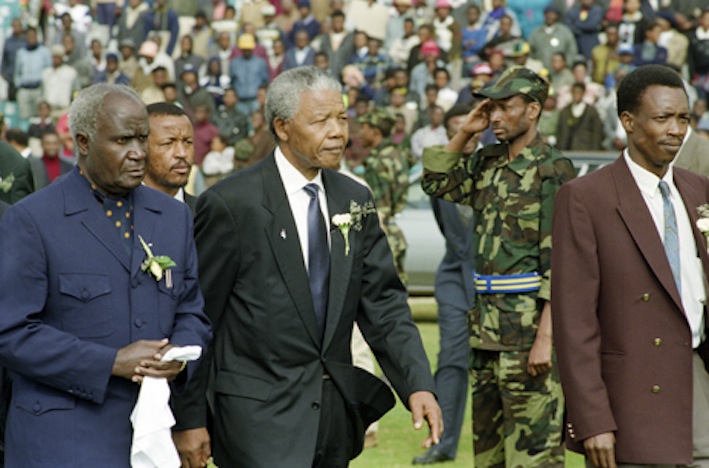
Nelson Mandela attends the lieing in state of ANC president OR Tambo at FNB stadium, Soweto, South Africa. (Greg Marinovich)
Before I proceed, I wish to make a few salient personal points:
- I must declare that this is a non-solicited presentation. It is only an outcome of the involuntary workings of my critical thinking mind and its creative processes. It is my subjective, free world intellectual response to the foul anti-Mandela vis-à-vis Kaunda sentiments I have seen expressed in the various social media platforms, particularly Facebook, for many years. It is not my goal to want to be malicious against anybody. Neither is it my intention to seek or expect approval, favours, or rewards from anybody.
This is an honest, independent expression of my thoughts and feelings with nothing but the very best of intentions. All this is done with the utmost respect both for Mandela and Kaunda, their respective families, and their followers through their respective foundations and other fora … (Continued in the book: “MACHONA BLOGS – As I See It”. Order Simon Chilembo books on Amazon)
Simon Chilembo
Welkom
South Africa
Tel.: +4792525032
February 13, 2018
INTRINSIC MOTIVATION IN A NATIONAL CONTEXT
Guiding questions:
1. What spurs a nation or a people to attain heights of development?
2. Is it a collective that is the main driver or a leader with “Intrinsic Motivation”

©Simon Chilembo 2018
NOTE
The article below is motivated by Mr Fisho Mwale. It arose from a Facebook interaction yesterday, Thursday, January 08, 2018. I was one of the respondents to his posting, “BUSINESS IDEAS”. In it, he referred to his personal family experiences to highlight some cultural impediments towards following up emergent business opportunities in our society.
Mr Fisho Mwale, summarizing his bone of contention, wrote, “Sometimes out of the box great business ideas do not work due to many factors such as timing, cultural values and lack of guts. You have to believe in your ideas and it’s important to get ‘buy in’.”
In agreement with him, I responded:
“… Great real-life entrepreneurial development case study material, …. Thanks for the insights, Sir! I wish to also add lack of what I call “Intrinsic Motivation” to the list of factors inhibiting follow-throughs to great business ideas and, indeed, opportunities arising from given circumstances.
“Intrinsic Motivation is an active killer-instinct driven desire and determination to achieve set goals, and beyond. That arising, perhaps, from chance opportunities, or those created in response to certain apparent societal, if not bigger natural conditions and/ needs. E.g. the cholera epidemic mentioned above. It works independent of external deliberate or unintended hindrances, and is often a profoundly personal journey. Seen from the outside, people in “Intrinsic Motivation” mode can appear to be selfish, reckless, one-track-minded, and defiant, amongst other negative personal attributes.
“This kind of motivation is ignited by desperate survival need circumstances too, if not a pure natural curiosity state of being. When pushed against the wall, without any possible manoeuvre or exit, fearless, “thrill-seeker”-type-people with strong wills to live will find the most ingenious ways to survive: creativity kindled to find the most unconventional solutions that could be developed into business models, subsequently.
I believe that we have to teach ourselves to be hungry enough, curious enough, and afraid enough to ignite our “Intrinsic Motivations” in order that they, pushing the continuum farther, ignite the killer-instinct guts necessary to get us to see things through, no matter the odds. It is a mind, attitude thing, really. Doable.”
The reply from Mr Fisho Mwale was gracious. He concluded by throwing me a challenge, “Thank you and I would love for you to expand more and discuss it from a National context …”
The latter got “… my Intrinsic Motivation to find, and engage with like-minded people about national development issues, plus possible solutions …” to shoot to the roof.
DEVELOPMENT: Attainment, Nurture, Sustenance.
In Social Science, the concept of Development is defined in terms of upward qualitative and quantitative transformation of society over time. Operationally, it means that from society’s observable benefits of this positive change, people will reflect higher and enduring frequencies of subjective states of contentment, hope, and belief in an ever bright future for all.
This state of affairs will be a manifestation of societies ability to provide for all the people’s basic short-term and long-term needs and wants for successful living from day-to-day, all their days: food, shelter, health, education, security, and more. Abundance is when society has a constant surplus of all the resources that are necessary to ensure that the people’s contentment levels do not dramatically spiral downwards in cases of natural calamities, wars, and, especially, population growth in time.
The objective side of Development is, therefore, operationally seen in the growth, in sheer numbers and magnitudes, of material and service values of all the tangible and intangible aspects of societal management towards lasting prosperity attainment. Herein come elements of:
- Infrastructure – water reservoirs, food production facilities (agricultural land, food processing plants, etc), housing, roads, hospitals, schools, power stations and grids, telecommunications, and others.
- Services – the entire spectrum of social amenities and necessary operational personnel across the board (health workers, engineers and other scientists, entrepreneurs, R&D, and many more), national security (police, military), including culture, i.e. the whole possibilities field of the creative arts.
- Longevity – In sustained development states, short of mortal accidents of all kinds, under variable circumstances, people tend to live into ripe old ages. Absence of private and societal want, as well as a general sense and state of well-being in society tend to have a life prolonging effect on the people: resilience against various life-threatening illnesses, and ever improving medical treatments of the same.
Because Development is about growth, and is forward-looking, it can be encapsulated in the concept of progress. This means that stages of development can be measured, and isolated in terms of space and time. Viewed in this regard, it ought to be understandable that Development entails a rise in complications of societal management and administration.
In the context of this presentation, management is about the allocation of resources in appropriate quantities to relevant material and service needs in developmental work. Administration, then, sees to it that resources are applied for their originally intended purposes, and according to stipulated rules with regard to predetermined decisive conditions.
Therefore, from the point of definitions above, for Development to succeed, it is imperative that it is spearheaded by people of at least as intellectually and culturally progressive as Development itself is inherently, and necessarily entails on its reality.
“INTRINSIC MOTIVATION” FOR DEVELOPMENT: The Collective? A Leader?
On the one hand, human beings are inherently self-centered as individuals. On the other, because human beings are, actually, also very smart, they realized a long time ago that to survive in an inherently hostile nature, they had to learn to live in collectives. We, as humans against other earthly creatures, owe our position at the top of the food chain to our ability to work together in our necessary efforts to tame aspects of nature for our, yes, Development (-al) needs … (Continued in the book: “MACHONA BLOGS – As I See It”. Order Simon Chilembo books on Amazon)
Simon Chilembo
Welkom
South Africa
Tel: +27 813185271
February 09, 2018
GOD IN MAN
SCIENTIFIC MAN OF GOD
Epigenetic inheritance theory has captured my fascination in a profound way. It has cast new insight into how I now think about the nature of man. That with reference to how I relate to man in the spontaneous, continuous process of writing and playing my own story as I go through the labyrinth of life. Some call it legacy.

©Simon Chilembo 2017
But I don’t really care much about “the legacy I shall leave behind”. If I do have a legacy, it has, actually, built, and shall sustain itself for as long as time wants it alive. Nevertheless, immortality is the goal. Who wants to live forever? I do. Why not?
All I care about is the integrity of the authoring of my life story lines as I dance my way through to my exit point of the maze that far, far away.
My hope is that my life story shall be read and judged with open, scientific minds, both whilst I still walk the face of the earth, and when I’m dead.
Thanks to epigenetic inheritance theory, I have finally seen the light: yes, the human body is, indeed, a temple of God. By extension, any other creature that subscribes to, and lives according to tenets of any prescribed faith, has its physical body as the temple of God; at least in the Western world’s perception of the Deity.
Even more precisely, the philosophical duality of God and her anti-thesis, Satan, is not only a construct of the core of man’s existential questions’ thinking: their abodes, heaven and hell, respectively, are, in fact, in the DNA of man.
There is no place called heaven outside the realm of man’s existence on earth. Neither is there a place called hell in the same illusory domain. Heavenly rewards, or satanic retributions for our virtues and sins, respectively, we live them accordingly right here on earth. When we die, we are dead: our DNAs have switched off from our consciousness, and so have the ideas of God, Satan, heaven, and hell.
It is only the unenlightened that fuss about life after death for the deceased. The human soul leaving the dead is as real, as independent, and as infinite as the universe. So, leave it alone. It knows how to take care of itself. Ever heard of a buried soul? They failed to bury Jesus.
It ought to make perfect sense that life-after-death is, indeed, a reality for the living only. Life goes on. But, living in the dark, and confronted with challenges of life with nature, the survivors seek answers outside of themselves. Finding no workable solutions out there, panic grips them. Fear of the unknown rules over their lives through and through … (Continued in the book: “MACHONA BLOGS – As I See It”. Order Simon Chilembo books on Amazon)
Simon Chilembo
Welkom
South Africa
Telephone: +27813185271
December 19, 2017
ZIMBABWEAN PSYCHOPATHS IN SOUTH AFRICA
HUMILITY NEVER HURTS
Because I’m, in this posting, addressing myself to psychopaths, I’m going to be linear in my thought expression. I’m going to deliberately make non-substantiated claims. I am not opening a discussion. I only need to let my frustration out. That is because I need to breathe, so that I can continue enjoying the made-to-last freedom and peace of my motherland, South Africa.
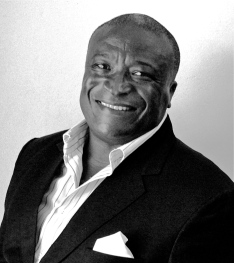
Simon Chilembo, Author/ President/ Machona-Emigrant
But, that does not mean that those strongly wishing to respond are prevented from doing so. There is one condition I demand to be fulfilled, though: substantiation and logically structured, mature presentation of opinions, agreeing with me or not. I shall not tolerate personal attacks and insults. If necessary, I’ll only engage with those whose views I regard to reflect a respectable degree of wisdom and intellectual sophistication, if not substance.
Psychopaths have no sense of right or wrong. Psychopaths have only one view of the world. Psychopaths see and interpret the universe only according to how their faultily wired perceptive and analytical senses relate to impulses emanating from their immediate and distant ecologies. Psychopaths lack empathy.
A fifty-six year old man progressively screws and holds his own country and people to ransom for thirty-seven years. Because he is a psychopath, Mugabe holds on to power even in senility. Wasted at age ninety-three, he continues clinging on to the no longer functional national presidency; totally oblivious to the real danger he personally, not to mention the almost 16.5 million people of Zimbabwe, is, are exposed to. That after a rather long overdue but, thank goodness, well-orchestrated military coup.
The Zimbabwean military intentionally chose not to assassinate Mugabe because of the non-psychopathic nature of the key generals and others involved in the coup, and his subsequent peacefully coerced resignation from power two weeks later. However, in their psychopathic minds, Mugabe and his like-minded have no comprehension of this fact.
Mugabe is finished. Mugabe is a lost cause. It is not worth wasting any more of my little breath left on him. I want to, now, address myself to the 5 million Zimbabweans who escaped from Mugabe’s tyranny to find protection in South Africa. 5 million is the whole population of a country – Norway, for example.
Other common and non-mistakable traits of psychopaths are acute arrogance, lack of respect, and ingratitude towards others, especially the generous, kind, and tolerant. (Originally) utterly desperate refugees from war torn Middle Eastern countries, and beyond, encounter rapidly growing hostilities from ordinary citizens in their Western Europe host countries.
The refugees do not understand how their religious and cultural chauvinism continually feed their hosts’ ill will. They are incapable of appreciating challenges around their own lack of willingness to change and adapt to the dynamics of their new environment. They are psychopaths. Thanks to them, the ultra-right wing wave keeps growing across Europe. Thanks to them, we now have Donald Trump as the most powerful man on earth.
In South Africa, there are Zimbabwean psychopaths who manifest exactly the same tendencies as above. Zimbabwean psychopaths in South Africa go around the country enjoying the very best freedoms and democratic rights no other African country can equal. Yet, the mentally deranged Zimbabweans behave so dishonourably towards their South African hosts it’s disgusting. And, then, naturally, they do not understand where the so-called Afro-phobia violence in the country comes from. Sickening to the core … (Continued in the book: “MACHONA BLOGS – As I See It”. Order Simon Chilembo books on Amazon)
Simon Chilembo
Welkom
South Africa
Telephone: +4792525032
November 26, 2017
FARM MURDERS
SOUTH AFRICAN FARM KILLINGS: Another Perspective

©Simon Chilembo 2017
I do not condone murder of any kind. Murder is murder, regardless of how it is classified on various platforms. No murder is worse or better than another. In the free world, we are all humans with infinite variable attributes, but equal in the face of the law of the land.
In the purest manifestation of God, we are all supposed to be equal because she created us that way, in her own perfect image.
Whilst I do not condone murder, left with no alternatives against any real, particularly unjustifiable, threat upon my life, or that of my beloved ones, including my lands, I could kill without thinking twice about it. In my world, there is no “turn the other cheek” contra injustice and evil intentions, or practices. If evil plucks out one of my eyes, I’ll pluck both of theirs, and more. It is what it is.
If I am a racist, it is more a circumstantially reactive tendency on my part, rather than it being an inherent disposition of mine. I hate racism with such passion I cannot help but want to give racists a taste of their own medicine whenever I encounter them in South Africa, and anywhere else in the world I find myself at any time; two eyes for an eye. Reconciliation modern South Africa style has its limits for me.
In characteristic, yet another demonstration of arrogance of power and privilege, a section of the white South African populace sensationalizes the killings of South African white farmers. As if these killings are a calculated, lopsided affair sponsored by the South African state, or some other organized, black peoples special interest entities.
As a humanist, whenever death strikes anywhere in the world, my heart ever goes out to the deceased and their bereaved families. The killing of a white South African farmer is no different from any other killing in the country, or anywhere else in the world. Therefore, I cannot feel relatively any more, or less empathy for the white South African farmer victims and their own … (Continued in the book: “MACHONA BLOGS – As I See It”. Order Simon Chilembo books on Amazon)
Simon Chilembo
Riebeeckstad
Welkom
South Africa
November 08, 2017
A FATHER IS GONE
REMEMBERING A SENIOR WARRIOR:
SVEIN SØRLIE
It is almost two weeks since Svein Sørlie died on Tuesday, August 15, 2017 in Norway. He shall be buried on Tuesday, August 29, 2017. I believe that wherever his soul is in the grander universe, it is thriving in the best conditions of the afterlife; resting in peace, hopefully. There is no rest for the hearts of gold. Gold is forever; larger than life. Such was Svein Sørlie as I knew him, feeling as if it had been all my life.
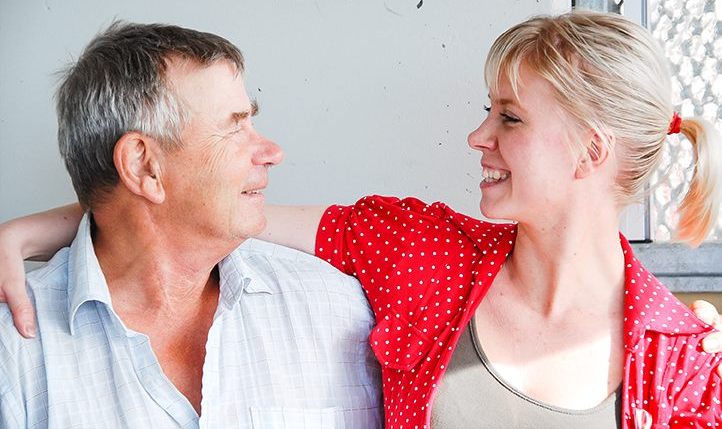
©Toril Sørlie 2017
Svein Sørlie: my student, my friend, my mentor, my protector. In time, he grew to represent a formidable father figure for me as I strove to curve a space of my own in a land that is not of my forefathers, Norway. With his death, it feels like a large chunk of Norway has just been ripped off my heart. The hurt I feel is profound.
I have known Svein, since March, 1989. During much of this time, I’ve watched with awe how he would ever so elegantly balance, sometimes in one and the same space, the role of a father, grandfather, brother, uncle, lover, in-law, friend, teacher, student, colleague, citizen, and community member. I could never get enough of the warmth and love that, on the one hand, Svein exuded, and received, on the other.
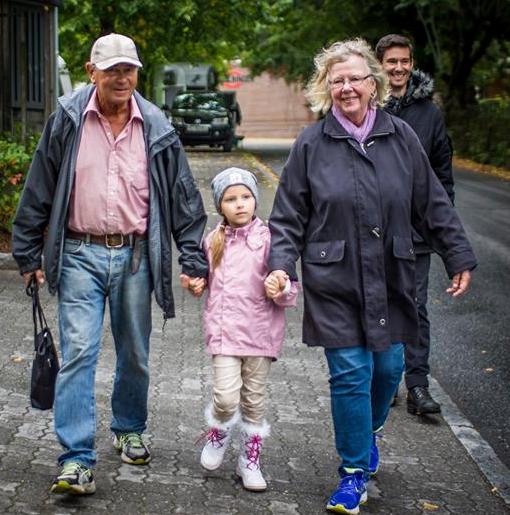
©Toril Sørlie 2017
It did not matter whether we were in Norway, or travelling in Greece or the UK; he was ever so easy to get along with. I guess it had to do with the aura of humility and compassion he radiated, long before he would open his mouth to greet people, and introduce himself to strangers.
Winter, spring, summer, or fall; dojo, camping, competitions, seminars, party, home, city centre, beach, everywhere: Svein Sørlie was the ever green, the ever wonderful. An IT expert, a former naval officer, and Judo adept, he was a knowledgeable and wise man; a man of the world. His terrific sense of humour made it a joy to talk with him about many subjects of common interest, any time.
On Wednesday, March 29, 1989, Anne-Britt Nilsen helped me arrange and host a public meeting to introduce Karate in the local community of Blåbærstien, Nesoddtangen. I was accompanied by my first ever Norwegian Karate student, Knut Arild Midtbø, who I had already started to train in Oslo since October, 1988. He would translate my message, since I hardly spoke a word of Norwegian, then.
In a packed, rather small community hall, the reception we received was mixture of curiosity, enthusiasm, scepticism, and outright hostility. During an altercation between my assistant, Knut, and a man who was totally against our mission in his neighbourhood, my eyes fell on a bespectacled older man. A little girl was sitting and playing at his feet. As our eyes met, the man gave me a gentle, reassuring smile; I thought the look on his face told me something like, “Never mind him!”
The friendly man was Svein Sørlie, and the little girl was his youngest child and daughter, Toril. For the next ten years or so, the Svein-Toril family duo would be the heart-beat of Blåbærstien Karate Klubb, now Nesodden Karateklubb. It was such that at a time when I had to make one of the most decisive choices in my life, I weighed my options against, amongst others, the joint pillar of strength Svein and Toril jointly represented for me in the club, if not the country Norway … (Continued in the book: “MACHONA BLOGS – As I See It”. Order Simon Chilembo books on Amazon)
Simon Chilembo
Welkom
South Africa
Telephone: +4792525032
August 28, 2017
A DECADE LATER
GROWING UP IN TEN YEARS
It is not as if much has changed since I entered the afternoon phase of my life. In my younger, less restrained rock and roll days, going out to a party meant, amongst others, getting told that I talked too much, too loud. Getting laid would also come as a matter of course, although not necessarily as a must; just a cool endeavour to engage in to seal yet another successful party night out.

©Simon Chilembo, Author, President 2017
On the afternoon of Friday, July 27, 2007, I embarked on a cross-border trip from Oslo, Norway, into Sweden. The destination was a recreational cottage village on the outskirts of the south-western city of Gothenburg. I know now that I really had not been keen on doing that trip. But I had to: duty called; business. I was exhausted after a hectic two weeks’ business tour across much of South Africa, from which I had arrived in Oslo the previous day.
There was also a distant, yet distinct enough, uneasy feeling about the double-events calling for the visit: a business partner’s birthday celebration on the day. The following day, July 28, it was scheduled the inaugural shareholders’ meeting for our newly-registered trading company.
I had had a theoretically substantiated notion that, despite the negative vibe I felt, everything would end up well. I couldn’t help but see the millions of dollars we were going to make as we went on to transform and dominate the Scandinavian health foods market.
On my part, I already saw how I’d use my share of the millions to help even more of my needy South African relatives’ children acquire decent education. The poverty levels of some of these people sear my heart ever so too much for comfort on any day.
Apart from a few new dark suits, a new Mercedes, and a new apartment in Oslo, I really had no reason to blow the monies on any more of my vanity needs. I already had my gold Rolex. So, I was cool.
As, on the morning of Saturday, July 28, 2007, I found myself driving my former business partner’s car on some unfamiliar country road, I immediately understood that something terribly wrong had happened. I wanted to believe that I was seeing myself in a nightmare, up until an almost frontal collision with an oncoming vehicle. Things had terribly gone wrong, alright. But, how? … (Continued in the book: “MACHONA BLOGS – As I See It”. Order Simon Chilembo books on Amazon)
Simon Chilembo
Welkom
South Africa
July 24, 2017
►Order Simon Chilembo books here.
ZAMBIAN KARATE HISTORY PROFILE: Professor Stephen Chan, OBE, 9th Dan
STEPHEN CHAN’S PIONEERING ROLE IN ZAMBIAN KARATE
Accomplishments and Impact in the Transformation of Martial Arts Culture
NOTES:
- This article is in response to a request by my friend and Martial Arts brother, Raymond Mbazima, Sensei, in June 2016, “Could you do a write-up of Professor Stephen Chan Sensei’s Pioneering Role in Zambia – in particular what he accomplished and his impact in the transformation of martial arts culture?”
- The article is an honest account of events as best as my memory serves me. I must apologize in advance for any inaccuracies, or misunderstandings that might arise. The names of the various people mentioned in the article are done so with but only respect and the fondest of memories. I’ll be failing if I didn’t acknowledge many of them as having helped mould the kind of man I am today, both inside and outside the dojo. None of them is directly responsible for my madness, though.
- Regarding the main subject of the article, Stephen Chan, the tone the article has taken is as it emerged from my heart, without fear or favour. That, in line with how my mind has interpreted the execution of his Martial Arts teacher and Godfather role towards me over the years; in four countries, Zambia, UK, Norway, and South Africa.
I have never felt that Stephen was compelled to work with me, neither have I ever felt that I was unduly expected to feel indebted to him for all that he has done for me. Therefore, I am under no obligation, I have no pressing need to aspire to sanctify, or flatter him. There is nothing egotistical to gain, nor intended to.
All this I shall summarize in Stephen’s own words in a correspondence pertaining to the article, “I do hope it is a lot more to do with mutual respect and camaraderie. I always pitched in with you on the floor – so we all suffered together.”
©Simon Chilembo 2017 Photo: Cynthia Reynolds
The article here initially covers the years 1981-85, a period of my first ever direct observation of Stephen’s physical presence, and martial arts work in Zambia. It will partially describe my personal experience of training and studying Karate with him as my Sensei at the UNZA Karate Club (UKC) in Lusaka. Little did I ever think then that thirty-five years on, the special student-master relationship would still be going strong; not only with me, but with many others of my generation the world over.
Following Stephen’s footsteps as a diverse collective spread across many parts of the world, the at least five generations of top-flight Karateka my contemporaries and I have produced continue to grow and benefit from his profound knowledge of, and love for the Martial Arts. Above all, perhaps, his broader love for, and service to humanity through his exemplary professional work and career continue to inspire many of us.
Secondly, the years 1986-88 are, in my opinion and personal experience, the period in which the relevance of Stephen’s impact on me would be tested to the limit. It would also test the unity and commonality of purpose in the then Seidokan Zambia core group he had developed at UKC.
Furthermore, this period would, by extension, define whether Stephen’s legacy in Zambian Karate would live on or not. I dare say that the modern Jindokai Zambia/ Zimbabwe family we have today can trace their roots to specifically that period. Had we at UKC failed to keep it together during those two years, the Zambian martial arts scene would have swallowed up Stephen Chan’s legacy for good, I am convinced.
It may be safe to say that Stephen’s work in the wider martial arts fraternity, within and outside the then Zambia Karate Federation (ZKF)’s framework, raised awareness of, and interest in the arts to unprecedented levels in the country. The man was, after all, the nearest living thing to Bruce Lee the people ever saw, came close to, touched, and spoke to.
Stephen made a striking presence on Television Zambia (TVZ)’s Sports Review shows, speaking, as Dennis Liwewe once said, “… fantabulous, beautiful English, indeed!”
The late Dennis Liwewe became a legend already in his own time as a passionate radio and TV sports commentator. If President Kaunda was Zambia’s football number one fan, Dennis Liwewe was in a class of his own as maestro supremo football commentator … (Continued in the book: “MACHONA BLOGS – As I See It”. Order Simon Chilembo books on Amazon)
Simon Chilembo, 6th Dan
Welkom
South Africa
Tel.: +4792525032
June 16, 2016
WHEN FRIENDSHIP DIES
FRIENDSHIP RULES

©Simon Chilembo 2017
Thinking about it as a grown up man, I’ve found that in my social interactions at all levels, I am driven by only two concepts: fairness and justness. The thesaurus lists the two as synonymous. Operationally, though, I take the liberty of applying “fairness” in relation to the good-bad duality; and “justness” to that of right-wrong.
I postulate, therefore, that if it is fair, it is good. It is uplifting. It is praiseworthy.
If it is unfair, it is bad. It is devious. It is condemnable.
If it is just, it is right. It is life supporting. It is revered.
If it is unjust, it is wrong. It is destructive. It is punishable.
When it comes to my friends, I have found fairness playing itself out in how they have accepted me in the way that I am. They have also allowed me to open doors into my life for them, equally accepting them for what and how they are. With the very closest of my friends, the mutuality of respect for one another’s strengths and fallibilities keeps me awake at night some times. It fills me with ever so much joy.
I have found justness playing itself out in hard times, especially.
It is the constant awareness of inter-personal fairness that keeps the love for my friends alive. Fairness constantly sensitizes me to elements of respect, tolerance, and moral codes cementing our friendship. These elements then extend to form the core of the interplay of justness as we all face and seek to overcome the intrinsic daily challenges of life, working either individually or collectively … (Continued in the book: “MACHONA BLOGS – As I See It”. Order Simon Chilembo books on Amazon)
Simon Chilembo
Welkom
South Africa
Tel.: +4792525032
June 16, 2017
MONEY ILLUSIONS
MEANING OF WEALTH
In material terms, wealth is the individual or collective accumulation of assets over time. In the context of this article, assets are items of value against which, in modern economic systems, monetary worth may be attached. These items may include land, structures built upon it, contents thereof and their applications towards management and accumulation of more wealth. They may also include objects perceived to be aesthetically precious, such as gold, diamond, pearls, and works of art of all kinds.
©Simon Chilembo 2017
Other items of value may be ownership of stock in business enterprises, and possession of hard transactional cash both outside and inside the banking system. A summation of all the mentioned gives total wealth of the individual, organization, or nation concerned. When liabilities are subtracted, a net worth is derived. The higher the net worth of an entity, the wealthier they are.
In principle, material wealth ought to facilitate acquisition and provision of life’s basic needs and wants, and much more, for those in possession and management of it. When this happens, a state of opulence has been attained. The wealthy, i.e. possessors of net positive wealth, are defined as such because their wealth gives them almost unlimited possibilities to access and acquire as their needs, wants, and demands dictate. This is manifestation of power. As to the judiciousness of the wealthy’s use of power in society is another discussion outside the scope of this presentation.
Genuine wealth is, by definition, a functionally non-static concept eroded over time. A state of poverty is reached upon when time has, for any reason, eliminated the symbols of, and access to wealth and the benefits thereof accruing for the formerly wealthy.
Wealth is regenerative, self-sustaining, and seeks to perpetuate itself indefinitely, to the extent that natural and social forces permit. Social forces referring here to the mechanisms through which society is organized politically, economically, and culturally. The essence of wealth is growth, that with reference to quantitative and qualitative aspects of existence, for both the individual and society. This denotes progress, leading to overall societal development.
At my age, 57 years old, I have reached a stage in life where, with a mixture of wonder and sadness, I have watched my contemporaries go through the most amazing transformations in life. Some have died; others are dead-people-walking with terminal diseases, or pursuing life-style choices slowly but surely sucking the lives out of them. There are those who have lost, and are losing their loved ones in the same fashion.
Many others have been married and divorced at least once. A few have found more fulfilling lives after divorce. Others have lost their children and everything they had owned, including self-control contra temptations of the world. The latter lead miserable lives of constant searches for ever non-gratifying pleasures of life, also dying slowly inside.
Some of them have, with varying degrees of success, even been on the suicide path more than once before. Watching them go by their tragic lives, every day is like on a tick-tock-tick-tock time bomb rhythm. When the lethal explosion finally comes, I hope it’ll find each one alone in each their valleys of death. I hope further that they will finally find peace on the other side, if the other side does exist at all … (Continued in the book: “MACHONA BLOGS – As I See It”. Order Simon Chilembo books on Amazon)
Simon Chilembo
Welkom
South Africa
Tel.: +27 81318 5271
June 15, 2017
 Simon Chilembo